China Top 10 Culture Stone Manufacturers for Global Buyers?
So, you're looking for the top 10 culture stone manufacturers in China for global buyers? This guide is about checking Chinese suppliers using real-world buying criteria—not just pretty catalog photos. Culture stone can turn a blank exterior into a textured wall, a garden path, or a cozy fireplace surround. But pick the wrong supplier and you might end up with uneven color, weak corners, or expensive replacement work down the road.
Frank Lloyd Wright, who knew a thing or two about natural materials, once said, "Study nature, love nature, stay close to nature. It will never fail you." That advice still lands for culture stone buyers. A believable stone surface should show natural variation. It shouldn’t look like the same factory pattern stamped over and over. The best manufacturers know how to balance visual character with solid engineering.
This comparison looks at quarry or raw-material access, cutting precision, surface finishing, thickness control, packaging, and export experience. It also covers sample approval, color consistency, moisture resistance, frost performance, and how fast they respond. These details matter. A sample can look perfect in showroom lighting, then look darker next to a window. That’s a risk worth paying attention to.
The manufacturers on the list may have different strengths. Some focus on split-face panels and thin veneer systems. Others are better with landscaping stone, cultured stone, or big architectural orders. Before signing contracts, buyers should verify certifications, test reports, production capacity, and recent project references. No ranking stays perfect forever. Factory teams change, material sources shift, and quality can vary from batch to batch.
So think of this article as a useful starting point, not the final purchasing decision. Ask for physical samples, confirm installation requirements, and talk about packaging photos before shipment. Often, good communication tells you more than a polished website.

Table of Contents [Hide]
1 What Is Cultured Stone? ASTM C1670 Definitions and Product Categories
2 China’s Cultured Stone Market: HS 6810 Trade Data and Export Trends
3 How to Rank the Top 10 Manufacturers: ASTM C1670 Testing and Quality Metrics
4 Top 10 Chinese Cultured Stone Manufacturers by Products, Capacity, and Markets
5 Global Compliance Guide: ASTM C1780, EN 13501-1, and ISO 9001 Requirements
6 Buyer Due Diligence: MOQ, Lead Time, Test Reports, and Factory Audit Standards
What Is Cultured Stone? ASTM C1670 Definitions and Product Categories
China Top 10 Culture Stone Manufacturers for Global Buyers?
Cultured stone is a manufactured masonry unit designed to resemble natural stone. It usually combines cement, lightweight aggregates, mineral pigments, and molded textures. The result is a lighter facing material for walls, fireplaces, façades, and landscape features. It is not simply painted concrete.
ASTM C1670 provides a technical framework for adhered manufactured stone masonry units. The standard addresses dimensions, physical properties, appearance, and durability. Buyers should review requirements for compressive strength, absorption, and resistance to repeated freezing and thawing. These details matter when panels face rain, frost, or strong sunlight. Ask for current test reports.
Product categories are often organized by visual profile and installation use. Ashlar pieces have clean, horizontal lines. Ledgestone offers narrow, layered faces. Fieldstone looks irregular and naturally weathered. Rubble profiles create rough, varied surfaces, while stacked stone emphasizes tight vertical courses. These names help comparison, but they are not always ASTM classifications.
A reliable supplier should provide samples, installation guidance, batch information, and clear tolerance data. Check the back surface, too. It should support proper mortar adhesion without excessive dust. Color variation is normal and often desirable. Still, some samples look better than full pallets. That deserves honest review. Variations in thickness can also affect labor, joints, and corner alignment.
China’s Cultured Stone Market: HS 6810 Trade Data and Export Trends
China Top 10 Culture Stone Manufacturers for Global Buyers?
China’s cultured stone trade is best examined through HS 6810. This code covers articles made from cement, concrete, or artificial stone. It also includes products beyond decorative wall panels. That distinction matters.
ITC Trade Map data, based on China Customs declarations, places China’s HS 6810 exports at approximately US$1.5 billion in 2023. The reported value was higher than in 2022, when exports were close to US$1.4 billion. Export demand remained visible across Southeast Asia, the Middle East, Europe, and North America. However, HS 6810 is only a proxy for cultured stone. It does not isolate every decorative stone product.
The export trend shows practical buyer priorities. Lightweight panels, exterior cladding, landscaping pieces, and prefabricated components are easier to ship. Freight costs still influence final pricing. Strong suppliers usually provide thickness records, water-absorption results, color samples, and packing photos. Ask for recent batch evidence, not only a polished catalogue.
The data has limits.
Different customs systems may use mirror statistics. Product descriptions can also vary between declarations. Buyers should compare HS codes, invoices, test reports, and shipment quantities before selecting a manufacturer. China’s export scale is significant, but scale alone does not prove consistent quality. Factory experience, production controls, and realistic lead times deserve equal attention.
How to Rank the Top 10 Manufacturers: ASTM C1670 Testing and Quality Metrics
For global buyers, ranking the top 10 culture stone manufacturers should begin with evidence, not showroom appearance. ASTM C1670/C1670M testing offers a practical quality baseline for adhered manufactured stone masonry veneer units. Request dated reports from competent, independent laboratories. Check the tested product, batch, dimensions, and production site. A report for one color may not represent every series. This detail is often missed.
Compare physical performance data, including water absorption, density, dimensional consistency, and freeze-thaw resistance where applicable. Review compressive or flexural results only when relevant to the specification and installation system. Reliable manufacturers explain test methods, sampling frequency, and corrective actions. During factory visits, inspect curing areas, pigment control, mold wear, packaging, and pallet labels. Ask for retained samples and traceability records. In my experience, repeatability matters more than one impressive result. Still, factory observations can be subjective. Record photographs, dates, and unanswered questions before assigning a rank.
Tips: Build a weighted scorecard. Give ASTM compliance and independent verification the highest weight. Add defect rates, lead-time stability, response speed, and replacement handling. Request recent samples from normal production, not specially prepared pieces. If records conflict, pause the ranking and order a second test. A careful buyer accepts uncertainty. Perfect data is rare.
Top 10 Chinese Cultured Stone Manufacturers by Products, Capacity, and Markets
China’s top 10 cultured stone manufacturers should be compared by products, capacity, and market reach, not factory size alone. Their portfolios typically include veneer panels, architectural ledgestone, thin stone, corner pieces, and custom molds. The strongest producers provide consistent color across batches, low water absorption, and realistic surface texture. Grand View Research identifies residential renovation and commercial construction as major growth drivers for manufactured stone. That demand rewards flexible product lines.
Capacity also needs practical verification. A large annual output sounds impressive, but kiln schedules, mold numbers, and quality-control staffing reveal more. China’s stone processing industry benefits from established supply chains for cement, pigments, molds, and packaging. Export-focused manufacturers commonly serve North America, Europe, Australia, and Southeast Asia. Their market experience should include container loading, moisture protection, pallet testing, and documentation. According to UN Comtrade trade data, China remains a significant global supplier of construction materials, yet export value alone cannot prove product reliability. Capacity alone can mislead.
Tips: Request recent production figures, not brochure estimates. Ask for batch samples, test reports, and photographs of packed containers. Compare CIF or FOB quotes carefully. A cheaper panel may require stronger wall preparation or create higher installation waste. Reviewers should also inspect color variation under daylight; factory lighting can hide differences. I have found this step easy to skip, and regrettable later. A ranking becomes more credible when products, verified capacity, destination markets, and after-sales response receive equal weight.
Global Compliance Guide: ASTM C1780, EN 13501-1, and ISO 9001 Requirements
China Top 10 Culture Stone Manufacturers for Global Buyers?
For global buyers, compliance begins with accurate documents, not attractive samples. ASTM C1780 addresses installation methods for adhered manufactured concrete masonry veneer. It is not a product certification. Buyers should confirm substrate preparation, mortar coverage, joint treatment, drainage, and installation training. Ask for current test reports and installation instructions matching the supplied stone system. A factory may provide good samples, yet its field guidance can remain incomplete.
EN 13501-1 classifies reaction to fire for construction products and building elements. The result depends on composition, thickness, backing, adhesives, and mounting conditions. Request the full classification report, test method, specimen details, and laboratory accreditation. Do not accept a fire rating copied onto a quotation. For European projects, also check whether a Declaration of Performance or other project documentation applies. Small changes in pigment or resin can affect testing.
ISO 9001 concerns the quality management system, not automatic product quality. Verify the certificate scope, issuing body, validity, production site, and surveillance status. Practical evidence matters: batch numbers, incoming-material records, dimensional checks, and corrective-action reports. Keep samples from each shipment. They help when color or texture changes unexpectedly. One weakness deserves honesty: many compliance files look complete but lack traceability. Buyers should compare documents with the exact model, batch, packaging, and destination requirements. A pre-shipment inspection remains worthwhile.
Buyer Due Diligence: MOQ, Lead Time, Test Reports, and Factory Audit Standards
China’s top ten culture stone manufacturers should be compared through evidence, not catalogue photos. A practical shortlist begins with MOQ, production capacity, and repeat-order flexibility. Ask whether the quoted MOQ applies per color, surface finish, or container. A low MOQ may hide higher unit costs. Get evidence.
Lead time needs a written breakdown. Request sample time, production time, inspection time, and port delivery separately. UNCTAD’s Review of Maritime Transport 2023 recorded about 858 million TEUs handled globally in 2022, showing the scale of container logistics and possible congestion risks. Add a buffer of seven to fourteen days for peak seasons. Confirm the shipment date, not merely the production date.
Test reports should identify the exact product batch. For exterior culture stone, request water absorption, compressive strength, freeze-thaw resistance, and dimensional tolerance results. ASTM C67 and relevant EN masonry standards provide useful testing references. ISO’s 2022 Survey reported more than 1.26 million ISO 9001 certificates worldwide, but certification alone does not prove product consistency. Review the certificate scope, issuing body, and renewal status. Factory audits should check raw-material storage, mold control, curing areas, calibration records, worker safety, and final packing. A video call is helpful. It is not a factory audit. I would also compare three recent batch reports, because one perfect report can be an exception.
China Culture Stone Supplier Due-Diligence Priorities
This reference scorecard allocates review attention across the four core checks commonly required by global buyers: factory audit, test reports, lead time, and MOQ. The percentages are evaluation weights, not performance claims for any specific manufacturer.
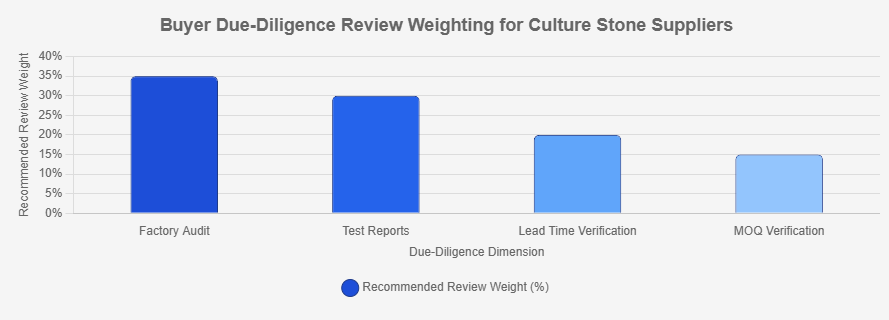
Buyers should verify MOQ and lead time in a signed quotation, request product-specific test reports against applicable standards such as ASTM, EN, or ISO requirements, and use a factory audit to review quality control, traceability, production capacity, and environmental compliance.
FAQS
What evidence should buyers request before ranking a cultured stone manufacturer?
Request dated, independent laboratory reports for the exact product and production site. Check the batch, color, dimensions, and test date. Showroom appearance is not enough. Details matter.
Which performance measurements are most useful?
Does one test report represent every product series?
How can factory capacity be verified?
What should buyers inspect during a factory audit?
How should minimum order quantities and lead times be reviewed?
What export details can reveal practical reliability?
How should a final ranking handle uncertain or conflicting information?
Conclusion
This guide provides global buyers with a practical framework for evaluating China’s Culture Stone industry. It explains the definition and main product categories of cultured stone under ASTM C1670, while introducing HS 6810 trade data as a useful reference for understanding market size, export trends, and product movement. It also outlines how to compare manufacturers through production capacity, product range, testing records, quality consistency, and experience serving international markets.
The article further reviews key compliance considerations, including ASTM C1780, EN 13501-1, and ISO 9001 requirements, helping buyers assess safety, performance, and quality-management systems. A detailed due-diligence checklist covers minimum order quantities, lead times, test reports, factory audits, packaging, and communication standards. By combining technical verification, documentation review, and supplier evaluation, buyers can reduce sourcing risks and select reliable Culture Stone manufacturers suited to their project requirements and destination-market regulations.
CATEGORIES
Payment Support
-
Below payment terms accpeted by us :
1.Telegraphic Transfer(TT);
2.Irrevocable L/C at Sight;
3.100% Full Cash;
4.Credit Payment (After Becoming Our Old Client For One Year);
5.You could get prices lower than our costs after US$10,000 is recharged into your VIP card, which is valid in half year.