10 Best Natural Stone Floor Types for Global Buyers
Picking out a natural stone floor isn't just about choosing a pretty color—it’s more about understanding what your space needs. When buyers are looking globally, they’ve gotta think about things like the geology of the stone, how the climate will affect it, how easy it'll be to maintain, how it’s installed, and how it’ll hold up over time. For example, marble can give your hotel lobby that sleek, polished look, but granite? That’s the tough guy—perfect for high-traffic spots near busy entrances. Limestone? It’s got this warm, cozy vibe but sometimes needs a bit of extra sealing to keep it in good shape. And slate? It’s got texture and grip—great for slip resistance—but find it’s a bit uneven for placing furniture easily.
In this guide, we’re looking at ten different natural stone options suitable for homes, commercial spaces, and hospitality settings. We’ll go over the practical stuff—hardness, how much water the stone absorbs, surface finish, cleaning needs, and what kind of use it’s best for. Keep in mind: quarry quality matters a lot too. The way the stone is processed can make a huge difference—an expertly calibrated tile will give you cleaner lines compared to a shipment that’s sort of a mixed bag, even if they’re both the same kind of stone. So, always ask suppliers for recent samples, technical details, finish options, and installation advice from folks you trust. Having experienced installers check things out can reveal issues photos alone might hide.
And let’s be real—natural stone isn’t perfectly uniform. That’s part of its charm, but it can cause some headaches when you’re ordering in bulk. Your sample isn’t going to show every little variation—shade differences, veins, tiny pits—these are all normal. It’s totally worth having honest conversations about these aspects before making a big purchase. Sometimes, after seeing things on-site, you might want to tweak your plans. It’s okay to admit that—even the most stunning stone might not perform well in a wet bathroom or a really cold climate. Ultimately, the best choice balances what you love visually with realistic expectations about how it will perform, where it’s sourced from, and what kind of upkeep it’ll need. By doing your homework and comparing options carefully, you can pick a floor that looks unique but also keeps its promises for years down the line.

Table of Contents [Hide]
1 What Defines a Natural Stone Floor?
2 How Natural Stone Flooring Is Classified
3 Granite: Strength for High-Traffic Areas
4 Marble: Distinctive Style for Refined Interiors
5 Limestone and Travertine: Warm, Textured Choices
6 Slate and Other Stones: Practical Global Options
What Defines a Natural Stone Floor?
A natural stone floor is cut from stone formed by geological processes, not manufactured from cement, resin, or fired clay. ASTM C119 identifies natural stone as a naturally occurring mineral substance used for construction. Common floor types include granite, marble, limestone, travertine, slate, and sandstone.
The surface should show geological character. Tiny crystals, fossil marks, veins, or uneven color are normal. They are not manufacturing defects. USGS Mineral Commodity Summaries 2024 recorded roughly 2 million metric tons of U.S. dimension-stone production in 2023, showing the scale of this established material sector. Yet production volume does not prove floor quality.
Performance depends on mineral structure, porosity, finish, and installation. A polished marble tile may reflect light beautifully, but its surface can scratch and etch near kitchens. Textured slate offers stronger visual grip, though its cleft surface collects grit. On site, buyers should request water-absorption, flexural-strength, and slip-resistance results. ASTM and ISO testing methods make comparisons more reliable. A Natural Stone Institute technical report also stresses matching stone selection with traffic, moisture, and maintenance conditions.
I have seen samples look perfect under showroom lights, then reveal uneven absorption after installation. That risk deserves attention. Ask for samples in dry and wet conditions. Inspect the back, edges, and calibrated thickness. Some “natural” floors still receive resin filling or surface sealing, so suppliers should disclose every treatment. Mistakes happen. Clear testing records reduce expensive surprises.
10 Best Natural Stone Floor Types for Global Buyers - What Defines a Natural Stone Floor?
| Stone Type | Geological Classification | Typical Mohs Hardness | Typical Water Absorption | Appearance | Recommended Floor Areas | Maintenance Level | Key Buying Consideration |
|---|---|---|---|---|---|---|---|
| Marble | Metamorphic carbonate rock | 3–5 | Usually 0.1%–2% | Veined, crystalline, and available in many colors | Bathrooms, entrances, living rooms, low-to-medium traffic interiors | Medium to high | Sensitive to acids and scratching; honed finishes generally hide wear better than polished finishes. |
| Granite | Igneous rock | 6–7 | Usually 0.1%–1% | Speckled or granular texture with strong color variation | High-traffic halls, kitchens, commercial interiors, outdoor areas in suitable climates | Low to medium | Check slip resistance, finish, frost suitability, and slab or tile thickness for the intended application. |
| Limestone | Sedimentary carbonate rock | 3–4 | Approximately 0.5%–15% | Soft, earthy colors with a calm and uniform visual character | Living rooms, bedrooms, patios, and lightly trafficked commercial areas | Medium to high | Porosity can vary substantially; sealing and regular cleaning are important, especially in wet areas. |
| Travertine | Porous limestone formed by mineral springs | 3–4 | Approximately 0.5%–5% or higher before filling | Natural voids, layered bands, and warm beige or ivory tones | Bathrooms, kitchens, terraces, corridors, and traditional-style interiors | High | Confirm whether holes are filled or unfilled; sealing is essential to reduce staining and moisture penetration. |
| Slate | Fine-grained metamorphic rock | 4–6 | Approximately 0.1%–2% | Layered texture with natural cleft surfaces and deep earthy colors | Entryways, kitchens, bathrooms, patios, and rustic or contemporary interiors | Medium | Evaluate cleft depth, flatness, edge quality, and freeze-thaw performance for exterior installations. |
| Sandstone | Sedimentary rock composed mainly of sand-sized grains | 6–7 for individual quartz grains; overall durability varies | Approximately 1%–10% or higher | Grainy texture with cream, tan, red, brown, or gray tones | Patios, garden paths, low-to-medium traffic interiors, and feature floors | Medium to high | Select dense, dimensionally stable material and verify resistance to water, salt, and weathering. |
| Quartzite | Metamorphosed quartz-rich sandstone | 7 | Usually 0.1%–1.5% | Crystalline, often subtly veined, with white, gray, green, or gold tones | High-traffic residential floors, commercial interiors, kitchens, and selected exteriors | Low to medium | Confirm that the material is true quartzite rather than a softer quartz-rich stone; test samples for absorption and durability. |
| Soapstone | Metamorphic rock rich in talc | 1–2.5 | Very low to low, commonly below 1% | Smooth, matte, and usually gray, greenish-gray, or charcoal | Low-traffic interiors, bathrooms, decorative areas, and heat-resistant applications | Medium | It resists acids and moisture but scratches easily; choose textured finishes and allow for gradual color changes. |
| Basalt | Fine-grained volcanic igneous rock | 6–7 | Approximately 0.1%–2% | Uniform dark gray to black color with a modern, minimal appearance | High-traffic floors, public spaces, kitchens, terraces, and contemporary architecture | Low to medium | Check for surface variation, porosity, thermal movement, and slip performance; dark surfaces may show dust and scratches. |
| Onyx | Decorative banded carbonate stone | 3–4 | Approximately 0.1%–2% | Translucent bands and dramatic patterns in warm or cool colors | Low-traffic luxury interiors, feature floors, foyers, and illuminated installations | High | Its beauty comes with brittleness and acid sensitivity; use suitable substrates, careful installation, and protective sealing. |
What defines a natural stone floor? Natural stone flooring is made from quarried rock that is cut into tiles or slabs and may be calibrated, honed, polished, brushed, flamed, or left with a natural cleft surface. Core selection factors include mineral composition, porosity, hardness, slip resistance, finish, thickness, dimensional tolerance, stain resistance, and suitability for the local climate and traffic level.
How Natural Stone Flooring Is Classified
Natural stone flooring is classified by geology, mineral content, porosity, hardness, and surface finish. The ten common types include granite, marble, limestone, travertine, slate, quartzite, sandstone, basalt, onyx, and soapstone. Granite and basalt are igneous stones with dense structures. Marble and onyx are metamorphic, while limestone and travertine are sedimentary. Slate splits naturally into thin layers. Quartzite often resists scratching better than marble, but its quality can vary.
The classification affects real purchasing decisions. Dense granite, basalt, and quartzite suit busy hotel corridors and commercial entrances. Limestone and travertine create softer textures, but their pores need careful sealing. Slate offers grip near wet areas, although uneven clefts can complicate cleaning.
Marble looks refined. It can also etch under acidic spills. Onyx and soapstone require more cautious handling and are less typical for heavy traffic. A neat classification still has limits.
Grand View Research estimated the global natural stone market at approximately USD 51 billion in 2023, showing strong international demand. However, market value does not prove flooring suitability. Buyers should request test data using ASTM C97 for absorption, ASTM C170 for compressive strength, and ASTM C880 for flexural strength. For cold climates, freeze-thaw results matter. For bathrooms, slip resistance matters more than polished appearance. I have seen attractive samples fail because the finish was too smooth. Classification should guide inspection, not replace it.
Granite: Strength for High-Traffic Areas
Granite remains a practical choice for high-traffic floors because its dense mineral structure resists scratching, impact, and daily abrasion. ASTM C615 sets a minimum compressive strength of 19,000 psi for qualifying granite dimension stone. It also limits water absorption to 0.40%. These figures explain its use in hotel lobbies, transit halls, airports, and busy retail spaces.
Traffic changes the decision.The U.S. Geological Survey’s Mineral Commodity Summaries 2024 reported approximately 1.9 million metric tons of U.S. dimension-stone production in 2023. Granite represented an important share of that category. For global buyers, this indicates an established supply base, but not identical quality everywhere. Quarry location, block consistency, finishing, and shipping distance still affect the final result.
Choose a fine-grained slab with stable color and minimal visible cracks. A flamed or honed finish can improve traction, especially near entrances. Polished granite looks impressive, yet it may become slippery when wet. That caveat matters. Granite is strong, but it is not maintenance-free. Fine grit can dull polished areas over time. In my experience, entrance mats and routine dust removal protect the surface better than aggressive cleaning chemicals. Buyers should request absorption, strength, slip-resistance, and batch-consistency test records before approval. Even then, appearance can vary between samples and delivered slabs. That is an unavoidable weakness in natural stone.
Marble: Distinctive Style for Refined Interiors
Marble: Distinctive Style for Refined Interiors
Marble gives interiors a depth that printed surfaces rarely reproduce. Each slab carries veins, mineral clouds, and slight color changes. That variation is the point, not a defect. Grand View Research estimates the global natural stone market will continue growing through 2030, supported by residential renovation and premium commercial projects. However, market growth does not make every marble suitable for every room.
Marble is a calcite-based stone, usually measuring about 3 to 5 on the Mohs hardness scale. It can scratch more easily than granite. Acidic liquids may also etch its surface. A honed finish hides small marks better, while polished marble reflects more light and shows spills sooner. On busy floors, installers often recommend larger tiles with carefully planned joints. Fewer joints can create a calmer visual field.
Check the slab first.
The U.S. Geological Survey’s Dimension Stone statistics show that stone value depends heavily on processing, quality, and application, not only quarry volume. This matters for global buyers. A low purchase price may conceal higher cutting, sealing, shipping, or replacement costs. ASTM testing can help verify water absorption, flexural strength, and slip performance. Still, test results cannot replace a site inspection. Moisture, footwear, cleaning habits, and daylight all change performance. No marble floor is maintenance-free, and that uncomfortable fact is often overlooked. Proper sealing helps, but it does not make marble stain-proof.
10 Best Natural Stone Floor Types for Global Buyers
Marble: Distinctive Style for Refined Interiors
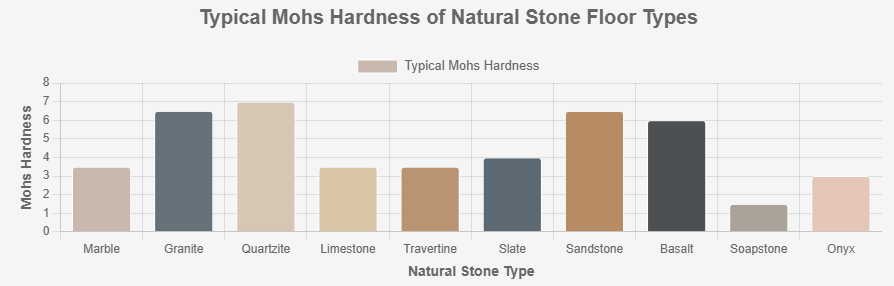
This comparison shows the typical Mohs hardness of ten natural stone flooring types. Higher values generally indicate better resistance to scratching, while marble remains popular for its refined appearance, distinctive veining, and suitability for elegant interior spaces. Natural stone characteristics can vary by quarry and mineral composition.
Limestone and Travertine: Warm, Textured Choices
Limestone and travertine bring warmth that polished stone often lacks. Their cream, sand, and honey tones soften bright interiors. Limestone usually offers a quieter surface, while travertine shows pores, bands, and naturally irregular movement. According to Grand View Research’s 2023 natural stone market report, the global market was valued at more than USD 50 billion in 2022. This demand reflects stone’s continued use in residential and commercial flooring.
Travertine feels tactile underfoot. Its filled pores create a smoother finish, while unfilled surfaces provide stronger visual texture. Limestone can suit large, calm rooms because its pattern is generally less dramatic. Both materials need careful sealing, especially near entrances, kitchens, and bathrooms. The Natural Stone Institute advises selecting cleaners with neutral pH, since acidic products can etch calcium-based stone.
Expect variation. It is part of the material.
In practical projects, I recommend ordering samples from different crates before approving a full installation. Shade differences may appear between tiles, even when they share one product description. Calibration also matters; uneven thickness can complicate grout lines and create lippage. A 2024 report from the International Trade Centre shows continued global trade in worked natural stone, but transport conditions and regional processing can affect consistency. Buyers should confirm thickness, slip requirements, water absorption, and finish in writing. Limestone and travertine are not maintenance-free, and promising otherwise would be careless. Their appeal comes from controlled imperfection, not factory uniformity.
Slate and Other Stones: Practical Global Options
Slate and Other Stones: Practical Global Options
For global buyers, slate is a strong starting point. Its layered texture adds grip near entrances, kitchens, and covered terraces. Dark slate can hide dust, but it may show white mineral marks after repeated mopping. Check sample pieces in daylight. Color often changes between quarry batches.
Granite suits busy hallways, retail floors, and large family homes. It resists scratching well when properly finished. Limestone feels warmer and softer underfoot, though acidic cleaners can etch its surface. Travertine offers natural holes and earthy movement. Those holes need careful filling and sealing. Marble brings refined veining, but it demands quicker cleaning after spills. Sandstone feels rustic and works best with suitable drainage. Quartzite provides strong performance, yet its name is sometimes used loosely in sales documents.
Basalt gives a modern, dense appearance and handles heavy use. Soapstone has a soft touch and resists many stains, but it can scratch more easily. Pebble stone creates textured shower floors, although uneven surfaces may challenge bare feet. In humid regions, slip resistance deserves more attention than polished appearance. In cold climates, confirm that the stone tolerates freeze-thaw cycles. I have seen attractive samples fail when installers ignored moisture beneath the tiles. That mistake is avoidable.
Ask for technical data, thickness consistency, water absorption, and slip testing. Confirm the recommended adhesive and grout for the installation climate. A local installer should inspect the substrate before ordering. One sample is not enough. Real stone is naturally imperfect, and that remains part of its character.
FAQS
Why does natural stone look different from printed surfaces?
Each slab contains unique veins, mineral clouds, and color shifts. Variation is natural, not necessarily a defect.
Is marble suitable for busy floors?
Should marble be polished or honed?
What should buyers check before ordering stone?
How do limestone and travertine differ?
Do limestone and travertine need sealing?
Which stones can suit humid or cold areas?
How can buyers reduce installation problems?
What cleaning approach is safest for calcium-based stone?
Is real stone completely uniform?
Conclusion
A Natural Stone Floor is made from quarried stone that is cut, shaped, and finished for interior or exterior flooring. Its appeal comes from authentic color variation, unique veining, natural texture, and long-term durability. Stone flooring can be classified by its composition, hardness, surface finish, porosity, and intended use, helping global buyers choose materials that match climate, traffic levels, maintenance needs, and design goals.
Granite is a strong, dense option for busy residential and commercial areas, offering excellent resistance to wear and scratches. Marble creates a refined appearance through distinctive veins and polished surfaces, making it suitable for elegant interiors. Limestone and travertine provide warmer tones, softer textures, and a relaxed natural character, although they may require suitable sealing. Slate and other stone types offer practical choices with varied colors, slip-resistant textures, and flexible applications. By comparing performance, appearance, installation conditions, and upkeep, buyers can select a natural stone floor that balances beauty, function, and long-term value.
CATEGORIES
Payment Support
-
Below payment terms accpeted by us :
1.Telegraphic Transfer(TT);
2.Irrevocable L/C at Sight;
3.100% Full Cash;
4.Credit Payment (After Becoming Our Old Client For One Year);
5.You could get prices lower than our costs after US$10,000 is recharged into your VIP card, which is valid in half year.