How to Choose Stone Customized Design for Global Buyers?
Global buyers are treating stone as a long-term design decision, not merely a surface purchase. Fortune Business Insights estimated the global natural stone market at USD 50.13 billion in 2023. The report projects continued growth through 2032, supported by construction, renovation, and premium interiors. This growth creates more choices, but also more confusion. Buyers must compare appearance, performance, sourcing, and documentation together.
Stone Customized Design begins with the project’s actual conditions. A hotel lobby may need stain resistance, consistent veining, and slip-controlled flooring. A private kitchen may require a specific edge profile, book-matched slabs, and heat-resistant finishes. Experienced suppliers should provide quarry information, slab photographs, thickness tolerance, water absorption data, and test results. The U.S. Geological Survey’s Mineral Commodity Summaries also shows why dimension-stone supply depends on extraction, processing, transport, and regional production capacity. A beautiful sample is not enough.
The safest choice connects visual intent with measurable performance. Ask whether the supplier can approve a physical sample before full production. Confirm color variation in writing. Check packaging, inspection procedures, replacement policies, and delivery responsibilities. Professional guidance from the Natural Stone Institute reinforces the importance of correct selection, installation, and maintenance. No checklist is perfect. Even a carefully approved stone may vary naturally between batches. That reality deserves clear communication, not promises of absolute uniformity. This guide helps global buyers assess Stone Customized Design with practical judgment, reliable evidence, and realistic expectations.

Table of Contents [Hide]
1 Define the Project Scope, Function, and Design Requirements
2 Select the Right Stone Type for Performance and Appearance
3 Compare Colors, Textures, Finishes, and Customization Options
4 Verify Supplier Skills, Samples, Quality, and Production Capacity
5 Review Global Standards, Packaging, Shipping, and Installation Needs
6 Confirm Pricing, Contracts, Timelines, and After-Sales Support
Define the Project Scope, Function, and Design Requirements
Choosing a stone customized design starts with a clear project scope. Define the application, installation area, quantities, dimensions, delivery location, and target completion date. A kitchen countertop needs different specifications from a hotel wall panel or an outdoor staircase. Measure twice. Small errors can create costly fabrication changes.
Function should guide the material selection. Record expected loads, moisture exposure, heat, abrasion, and cleaning methods. For example, exterior paving may require slip resistance and freeze-thaw durability, while a bathroom vanity needs low water absorption and carefully sealed edges. Ask for technical data, test reports, and finish samples. A polished surface may look attractive under showroom lights but reveal scratches or water marks in daily use. Real projects often change. Allow reasonable tolerance for cutting, joints, and natural color variation.
Design requirements should be documented in drawings, written specifications, and approved samples. Clarify veining direction, edge profiles, corner details, surface finish, allowable shade variation, and packaging standards. Digital images can misrepresent tone, so inspect a physical sample under similar lighting. A first specification is rarely complete. Recheck it with the architect, fabricator, installer, and buyer before production. Details matter. Missing a drainage slope or joint location can affect both appearance and performance. For international orders, confirm measurement units, labeling, import documentation, and local building requirements early.
Select the Right Stone Type for Performance and Appearance
Choosing stone for a customized project requires more than matching a color chart. Start with the site conditions, intended use, and maintenance plan. Granite often suits busy floors and outdoor areas because it offers strong abrasion resistance. Marble provides distinctive veining, but acids can dull its surface. Limestone feels warm and natural, yet its higher porosity may require careful sealing.
Performance should guide appearance, not follow it.Check water absorption, flexural strength, slip resistance, and freeze-thaw performance when selecting stone for demanding environments. For exterior walls, ask how the stone reacts to sunlight, rain, and temperature changes. For kitchen surfaces, test resistance to staining and common household acids. A honed finish can reduce glare, while a textured finish may improve traction. Small details matter.
A physical sample is essential. Digital colors can hide mineral variation. I have seen a polished sample look perfect, while full slabs revealed open veins and shade changes. That difference is not always a defect, but it must be accepted early. Request samples from several batches and confirm thickness, edge profiles, finish consistency, and allowable color variation in writing. Independent laboratory reports can support supplier claims, although testing alone cannot replace practical review. I would also inspect a small mock-up before approving mass production. It may slow the schedule. It can prevent an expensive mistake. Some designs look impressive on paper but feel too cold, slippery, or difficult to maintain in daily use.
Compare Colors, Textures, Finishes, and Customization Options
How to Choose Stone Customized Design for Global Buyers?
Color should fit the room’s light, not only a catalog photograph. Warm beige can soften a hotel lobby, while dark charcoal creates a stronger visual anchor. Grand View Research estimated the global natural stone market at over USD 50 billion in 2023, showing the scale of international demand. Yet, color consistency remains difficult because each quarry block can vary.
Texture changes the emotional and practical character of stone. Veined surfaces add movement, while uniform textures support large wall panels. Polished finishes reflect more light but reveal fingerprints, scratches, and uneven substrate conditions. Honed finishes feel quieter and hide minor marks better. Brushed or flamed finishes provide stronger grip for exterior areas, though they may require more cleaning. ASTM testing, including water absorption and strength checks, should guide suitability for each climate. Appearance alone is not enough.
Tips: Request a full-size sample. View it in daylight and artificial light. Compare wet and dry surfaces. Confirm slab batch, thickness, edge profile, and installation tolerances before production. Ask for digital drawings with actual vein direction. I once approved a small sample too quickly; the full slab looked much bolder. That mistake still matters. Customization also includes cutouts, book-matching, curved edges, and mixed finishes, but every added detail increases fabrication risk and lead time. A clear approval sheet protects both buyer and fabricator.
How to Choose Stone Customized Design for Global Buyers?
Compare the practical design flexibility of widely used natural stone categories across color variation, texture expression, finish compatibility, and customization potential. Scores are normalized planning benchmarks on a 100-point scale; actual results vary by quarry, slab selection, fabrication method, and surface treatment.
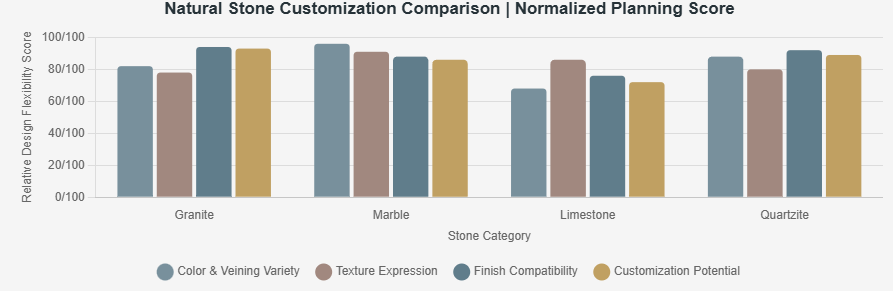
Granite and quartzite generally offer strong finish durability and customization potential for high-traffic applications. Marble provides distinctive color and veining, while limestone is often selected for softer textures and natural, understated surfaces. Buyers should confirm slab consistency, thickness, edge profiles, fabrication tolerances, and finish samples before approving a customized order.
Verify Supplier Skills, Samples, Quality, and Production Capacity
Custom stone design demands more than attractive drawings. Grand View Research valued the global natural stone market at about USD 51.08 billion in 2022. Competition is intense. Supplier verification therefore matters.
Request project photos, workshop videos, and technician qualifications. Ask how digital drawings become cutting files. A capable supplier should explain vein matching, edge profiles, tolerances, and repair procedures. Review a full-size sample when possible. Small samples may hide color variation, resin marks, or open pores. Test the sample against the agreed finish, thickness, and water-absorption requirements. ASTM C97/C97M supports absorption and specific-gravity testing for dimension stone. ASTM C880 covers flexural strength. Independent laboratory results are more reliable than promises.
Tips:Create a signed sample board. Record stone name, finish, dimensions, acceptable variation, and inspection points. Confirm capacity with monthly output, machine lists, staffing, and current production schedules. Compare these details with your order volume and delivery window. The Natural Stone Institute’s Dimension Stone Design Manual also provides useful guidance for fabrication and installation decisions. Grand View’s market data shows opportunity, but capacity claims still need evidence. A factory may own modern equipment yet lack skilled operators. That weakness is easy to miss. Ask for a live video inspection, recent inspection records, and packaging photos. I would also allow extra stone for replacement pieces; exact matching is rarely perfect.
Review Global Standards, Packaging, Shipping, and Installation Needs
Choosing stone for global buyers means reviewing more than color and surface. Packaging, shipping, and installation can decide whether a beautiful design succeeds. UNCTAD’s Review of Maritime Transport 2023 reports that over 80% of world merchandise trade by volume moves by sea. Stone therefore needs seaworthy packaging, not only attractive presentation.
Use strong, ventilated crates with foam, corner guards, and separated slabs. Mark weight, lifting points, and “this side up” clearly. Wooden packaging should follow ISPM 15 requirements, including approved treatment and marking. Moisture barriers help, but sealed wet stone can develop stains. That detail is often missed. Review the buyer’s import rules, port conditions, and unloading equipment before production. The World Bank’s Logistics Performance Index 2023 also shows major differences in customs, infrastructure, and delivery reliability between markets.
Tips: Request the installation substrate, climate, joint layout, and adhesive specification before cutting stone. Confirm slab thickness and tolerances with recognized technical standards, such as ASTM or EN requirements. Send a labeled sample crate for approval. It may feel slow. It prevents expensive mistakes. Installation drawings should show orientation, fixing points, movement joints, and replacement pieces. Natural stone can vary in shade and veining, even within one batch. A perfect digital rendering cannot promise identical panels. Leave room for reasonable variation, and record final approvals in writing.
Confirm Pricing, Contracts, Timelines, and After-Sales Support
When global buyers choose customized stone, pricing must cover more than the material itself. Ask for the stone grade, slab thickness, finish, edge profile, cutting pattern, packaging, and delivery term. Grand View Research estimates the global natural stone market reached about USD 51 billion in 2023. That scale creates price pressure, but cheap quotations often exclude technical details. Request a line-by-line quotation, approved drawings, and a physical sample before production. A small color difference can become a costly installation problem.
Contracts should define every milestone: deposit, drawing approval, production, inspection, loading, and arrival. State acceptable tolerances for dimensions, veining, color, moisture, and surface defects. Include the delivery term, export documents, inspection method, delay responsibility, and payment release conditions. UNCTAD reports that maritime shipping carries over 80% of global merchandise trade by volume. Port congestion still disrupts schedules. A perfect timeline is usually fiction. Build reasonable buffer days, especially before project installation.
After-sales support needs practical evidence, not warm promises. Require packing photos, loading records, spare pieces, care instructions, and a named response contact. The warranty should explain who pays for replacement stone, re-cutting, and transport. I have seen buyers focus heavily on the purchase price and ignore installation coordination. That decision often creates the real loss. Keep approved samples and signed drawings until the project closes. Some defects are visible immediately; others appear after sealing, lighting, or seasonal temperature changes.
FAQS
How should I choose a stone type for a customized project?
Start with the site conditions, intended use, and maintenance plan. Performance should guide appearance. Granite suits busy floors and outdoor areas because it resists abrasion. Marble offers strong veining, but acids can dull its surface. Limestone feels warm and natural, yet it absorbs more water. Small details matter.
Which stone properties should I check for demanding environments?
Which finish can improve safety and comfort?
Why is a physical stone sample important?
What details should be confirmed before mass production?
How should natural variation in stone be managed?
What packaging is suitable for international stone shipping?
What installation information should be collected before cutting stone?
Conclusion
Choosing the right Stone Customized Design begins with clearly defining the project’s purpose, location, dimensions, budget, performance expectations, and visual goals. Buyers should evaluate how the stone will be used, then select a suitable type based on durability, maintenance, climate, safety, and appearance. Comparing colors, textures, surface finishes, edge profiles, patterns, and fabrication options helps ensure the final result matches the intended design while remaining practical.
Before placing an order, global buyers should assess the supplier’s technical expertise, review material samples, inspect quality-control procedures, and confirm production capacity. It is also important to clarify applicable standards, protective packaging, shipping arrangements, installation requirements, and site conditions. A complete agreement should state specifications, quantities, pricing, payment terms, lead times, inspection procedures, warranties, and after-sales support. Careful communication and documented approvals can reduce misunderstandings, control risks, and help deliver a customized stone solution that meets both design expectations and functional requirements.
CATEGORIES
Payment Support
-
Below payment terms accpeted by us :
1.Telegraphic Transfer(TT);
2.Irrevocable L/C at Sight;
3.100% Full Cash;
4.Credit Payment (After Becoming Our Old Client For One Year);
5.You could get prices lower than our costs after US$10,000 is recharged into your VIP card, which is valid in half year.