What Are the Most Popular Types of Natural Stone?
Natural stone isn't just one thing — it's not a single look or a one-size-fits-all performance category, you know? Granite, marble, limestone, travertine, slate, and quartzite all come about in different ways, so it makes sense that their colors, patterns, and practical limits vary quite a bit. Take a polished marble countertop: it might have those delicate veins running through it, while a cleft slate tile feels totally different underfoot — much more textured. Granite tends to get picked for busy surfaces, sure. But here's the thing: no stone is completely maintenance-free in every setting.
Architect Louis Kahn once said, “Even a brick wants to be something,” and honestly, that pretty much sums up natural stone. It’s not just about how it looks—real character comes from where it came from, not just the finish you put on it. But here’s the thing: appearances can totally fool you. You’ve gotta consider porosity, hardness, how the surface was treated, and even whether it’ll come into contact with acids. Oh, and that sample you loved under the showroom lights? It might look completely different sitting next to a kitchen window.
Okay, so this guide basically covers the most popular stone types out there—how they look, where you'd use them, and how much upkeep they need. We also clear up a mix-up that trips up a lot of people: natural quartzite is actual stone, formed in the earth over time. Engineered quartz, on the other hand, is man-made. Yeah, it's a small distinction, but a pretty important one. There's no single “best” stone, honestly. What's right for you depends on the room, the wear and tear you expect, and, well, how willing you are to keep up with maintenance. And even then, no guide can cover everything—every slab is naturally unique, so comparisons only go so far. I mean, that’s part of the appeal, you know? And yeah—sometimes it’s also the frustrating part.

Table of Contents [Hide]
1 How Natural Stone Is Classified for Building and Design
2 Granite: A Hard, Durable Stone for High-Traffic Surfaces
3 Marble: A Distinctive Stone Valued for Its Veining
4 Limestone: A Versatile Stone with a Soft, Natural Look
5 Travertine: A Porous Stone with Characteristic Surface Texture
6 Slate: A Layered Stone Used for Roofing and Flooring
7 Quartzite: A Dense Stone with Strength and Color Variation
How Natural Stone Is Classified for Building and Design
Natural stone is commonly grouped by geological origin: igneous, sedimentary, or metamorphic. These categories describe how rock formed, not a guaranteed level of quality. Igneous stones, such as granite, cooled from molten material and often contain visible crystals. Sedimentary stones, including limestone and sandstone, formed from accumulated particles or minerals. Metamorphic stones, such as marble and slate, changed under heat and pressure. The categories are useful, but not always enough to guide a design choice.
For building and design, professionals also classify stone by practical behavior. Porosity, hardness, grain structure, and mineral content affect water absorption, staining, wear, and maintenance. A polished marble surface can make veining stand out, while a honed finish reduces glare. Granite is often chosen for busy counters, but performance varies with its composition and finish. Names alone are not enough.
Classification helps narrow the options; testing confirms suitability. Check a sample against the intended setting, especially where freezing temperatures, spills, or heavy foot traffic are expected. Ask for absorption and slip-resistance data when relevant. Compare the actual batch, too, since color and texture can vary. Test the sample. Natural variation gives each stone character, but it can complicate matching during repairs.
Popular Natural Stone Types: Classification and Typical Mohs Hardness
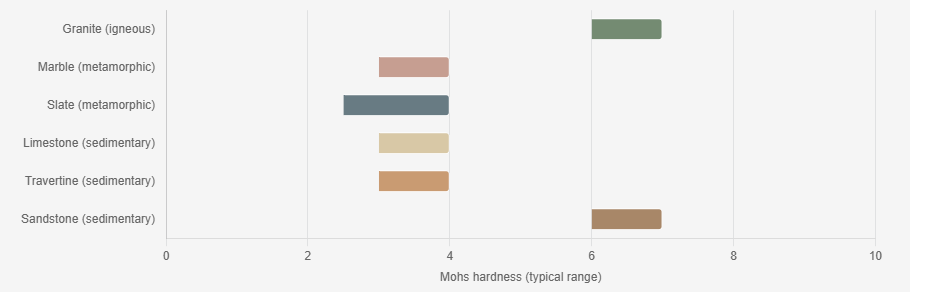
Natural stones are commonly grouped by how they form: igneous granite, metamorphic marble and slate, and sedimentary limestone, travertine, and sandstone. The bars show typical Mohs hardness ranges, where higher values indicate greater resistance to scratching. Actual hardness varies with mineral composition, and hardness alone does not determine whether a stone is suitable for a particular application.
Granite: A Hard, Durable Stone for High-Traffic Surfaces
Granite is a popular natural stone for busy kitchens, entryways, and commercial counters. Its interlocking minerals make it hard, and many slabs withstand daily wear well. Look closely, and you may see flecks of quartz, feldspar, and darker minerals. Each slab has its own pattern, so a small sample may not show the full variation.
For high-traffic surfaces, a honed or polished finish can affect both appearance and upkeep. Polished granite reflects light, while a honed surface feels more matte and may show marks differently. Still, it is not indestructible. Heavy cookware can chip an edge, and grit under a sliding appliance may scratch the surface. Wipe spills promptly, especially acidic liquids, and use a cutting board. Sealing needs vary with the stone’s porosity and finish; follow a qualified fabricator’s care advice rather than assuming every slab needs the same schedule. Granite can be forgiving, but it still rewards a little attention.
Marble: A Distinctive Stone Valued for Its Veining
Marble: A Distinctive Stone Valued for Its Veining
Marble is a metamorphic stone, formed when limestone changes under heat and pressure. Mineral traces create its distinctive veins, which may appear as fine threads, cloudy bands, or bold diagonals. No two slabs are exactly alike. That variation gives a countertop or fireplace surround a natural focal point, but it can make matching pieces difficult. A pale slab may also show darker veins more clearly under bright, direct light.
Look at the full slab before choosing it, not only a small sample. Check how the veins travel across the surface and where seams would fall. A dramatic pattern can be beautiful, yet it may feel busy in a compact room. Marble is also relatively soft and reacts to acidic liquids such as lemon juice. Etching can dull the finish, even when the stone is clean. That trade-off is easy to underestimate.
Tips: Ask to see the actual slab in natural light. Wipe spills promptly, use a suitable sealer, and choose a honed finish if you prefer a softer, less reflective look. Sealers reduce staining risk, but they do not prevent etching.
Limestone: A Versatile Stone with a Soft, Natural Look
Limestone is a sedimentary natural stone formed mainly from calcium carbonate. Depending on the quarry, it may show tiny fossil fragments, delicate veining, or a nearly even grain. Colors often range from warm ivory and sand to soft gray. The surface can feel calm rather than dramatic. It feels quiet. Honed limestone has a matte finish that suits relaxed interiors, while a brushed finish brings out subtle texture under changing light.
That gentle look works well for floors, fireplace surrounds, and bathroom walls, but limestone needs thoughtful care. It is relatively porous, so sealing can help reduce staining; the protection may need renewing over time. Because calcium carbonate reacts with acids, lemon juice, vinegar, and some harsh cleaners can etch the surface. Use a pH-neutral stone cleaner and wipe spills promptly. For flooring, ask a qualified installer to assess the stone, finish, and expected foot traffic before choosing it. Limestone varies from slab to slab, which gives a room character but can make matching pieces difficult. Its softness is part of its appeal, yet it is not carefree. A sample viewed in the actual room can reveal how its color shifts in daylight and warm evening light.
Travertine: A Porous Stone with Characteristic Surface Texture
Travertine forms when mineral-rich water deposits calcium carbonate, often leaving visible pores, soft bands, and warm cream or rust tones. Those openings give the stone its character. Small pits matter. Some are filled during processing; others remain open, creating a more tactile surface. I would not call every pit a defect. The key is knowing whether the finish suits the room and how much upkeep you accept.
The U.S. Geological Survey’s 2024 Mineral Commodity Summaries estimated U.S. dimension-stone output at roughly 2.5 million metric tons in 2023; its figures do not separate travertine from other stone types. That scale offers useful market context, but not a durability rating for any single slab.
For that, request test results for the specific material. ASTM C97 measures water absorption and bulk specific gravity, both relevant to porous stone. In kitchens or wet areas, ask whether the surface is filled and sealed, and follow the supplier’s care guidance. A honed finish feels quieter underfoot; a tumbled finish keeps edges and pits more visible. Travertine rewards close inspection, though its variation can make matching pieces harder than expected.
Slate: A Layered Stone Used for Roofing and Flooring
Slate is a fine-grained stone that splits along natural layers, producing thin tiles with slightly varied edges and surfaces. It is used for roofing and flooring, but the right grade and thickness depend on the job. The U.S. Geological Survey’s Mineral Commodity Summaries 2024 estimated U.S. dimension-stone output at about 2.6 million metric tons in 2023. That figure covers multiple stones, not slate alone, so it should not be read as a slate production total.
On a roof, slate’s weight calls for a suitably strong structure, careful fixing, and well-detailed flashing. Individual tiles can differ in thickness, so experienced installers sort them and adjust overlaps to keep rain moving toward the eaves. Small details matter. For floors, slate offers a firm, textured surface, but cleft finishes may feel uneven underfoot and can hold dirt in their grooves. Sealing may reduce staining, though it does not make every slate equally resistant to water or wear. Check the stone’s source, intended use, and technical data before specifying it; appearance alone is not enough. Even then, natural variation can make matching replacement tiles difficult.
Quartzite: A Dense Stone with Strength and Color Variation
Quartzite is a natural stone formed when sandstone changes under heat and pressure. Its dense structure makes it a popular choice for kitchen counters, bathroom vanities, and other hardworking surfaces. Color can range from soft white and gray to green, pink, or warm gold, often with flowing veins. No two slabs are exactly alike. A polished surface catches light, while a honed finish feels quieter and less reflective.
Despite its strength, quartzite is not maintenance-free. Some varieties absorb moisture more readily than others, so ask a stone professional about the specific slab and whether it needs sealing. A small water test can offer a clue, but it does not replace expert assessment. Wipe spills promptly, especially wine or citrus, and use a cutting board to protect the finish. It feels cool. That matters on a busy counter, though the stone can also feel visually cold in a pale, minimal room. View the actual slab in natural light before choosing; showroom lighting can hide subtle shifts in color and veining.
What Are the Most Popular Types of Natural Stone? - Quartzite: A Dense Stone with Strength and Color Variation
| Category | Typical Quartzite Characteristics | Practical Considerations |
|---|---|---|
| Geological formation | Quartzite forms when quartz-rich sandstone is altered by heat and pressure, causing the quartz grains to recrystallize and interlock. | Natural stone varies from slab to slab; color and pattern are not completely uniform. |
| Mineral composition | Composed mainly of quartz, with smaller amounts of other minerals that may influence its color and veining. | Mineral content varies by deposit and can affect the stone’s appearance and properties. |
| Hardness | Quartz has a Mohs hardness of 7, and quartzite is generally considered a hard, scratch-resistant natural stone. | Hardness does not make a surface immune to chips, impact damage, or wear in every application. |
| Density and strength | Typically dense and strong, although exact physical properties vary among varieties and individual slabs. | For structural or high-traffic use, select material based on supplier test data and project requirements. |
| Color range | Common colors include white, gray, beige, and brown; iron-bearing minerals and other impurities can create pink, red, or green tones. | View the actual slab before purchase, since samples may not show the full color range or pattern. |
| Pattern and veining | May have a granular, layered, or strongly veined appearance, depending on its formation and mineral content. | Book-matching or directional layout may be possible, but pattern continuity is not guaranteed. |
| Common finishes | Available finishes commonly include polished, honed, and brushed or textured surfaces. | Finish affects appearance, feel, and maintenance; textured surfaces may require more effort to clean. |
| Typical uses | Used for countertops, flooring, wall cladding, fireplace surrounds, and other interior or exterior applications. | Suitability depends on the specific stone, installation details, exposure, and local conditions. |
| Stain resistance | Quartzite is not automatically stain-proof; absorption varies with the stone and its finish. | Test the specific slab and use a suitable sealer if recommended by the stone professional. |
| Routine care | Regular cleaning with a soft cloth and a pH-neutral stone cleaner is generally appropriate. | Avoid acidic or abrasive cleaners unless the stone-care professional confirms they are suitable. |
Characteristics are general and can vary by quarry, slab, finish, and testing method. Confirm the properties and care requirements of the specific stone before installation.
FAQS
What gives limestone its soft, natural appearance?
Limestone forms mainly from calcium carbonate. It may show tiny fossils, fine veins, or an even grain. Colors include ivory, sand, and soft gray.
Where does limestone work well indoors?
How should limestone be cleaned and protected?
Should I check limestone in my room before choosing it?
What should I consider before using slate on a roof?
Is slate comfortable and easy to clean as flooring?
Does sealing make every slate tile water-resistant?
What does the reported stone-production figure say about slate?
Conclusion
Natural Stone is classified by its mineral composition, formation, hardness, texture, and appearance. These qualities influence how each stone performs and where it is best suited in building and design. Granite is hard and durable, making it a practical choice for high-traffic surfaces. Marble is prized for its distinctive veining, which gives interiors a refined, individual look, while limestone offers a softer, natural appearance that works across a range of settings.
Other popular types have their own defining characteristics. Travertine’s pores and textured surface create a distinctive, organic finish. Slate forms in layers and is commonly used for roofing and flooring, where its natural variation adds visual interest. Quartzite is dense and strong, with colors that can range from subtle to bold. Understanding these differences helps designers and homeowners choose stone that balances appearance, durability, and the needs of a particular space.
CATEGORIES
Payment Support
-
Below payment terms accpeted by us :
1.Telegraphic Transfer(TT);
2.Irrevocable L/C at Sight;
3.100% Full Cash;
4.Credit Payment (After Becoming Our Old Client For One Year);
5.You could get prices lower than our costs after US$10,000 is recharged into your VIP card, which is valid in half year.