Top Natural Stone Types for Interior Design
Here's the thing about stone: it can set the mood of a room long before you bring in a single piece of furniture. The color, the veining, the texture, even the finish—they all change how light moves across a surface. But if you pick a stone just because it looks pretty in the showroom, you might be setting yourself up for some expensive regrets. There's a whole family of interior natural stones—marble, granite, limestone, travertine, slate, quartzite—and they're definitely not all the same. Each one has its own strengths, its own care routine, and its own quirks. Some stain or scratch way too easily. Others are so visually busy they can make a small room feel overwhelming. And that's something worth thinking about before you commit.
So, this guide is all about natural stone in interior design—the popular types, anyway. We’ll get into the nitty-gritty for kitchens, bathrooms, floors, fireplaces, and those accent walls. You’ll see how durability, porosity, and finish matter, plus how to clean and care for things. And hey, stone changes over time—that’s part of its charm. A polished marble island, for instance, will bounce those pendant lights around beautifully, but a honed finish? It dials down the glare and shows wear in its own way. You’d think granite would be a no-brainer for busy areas—and it kind of is—but don’t sleep on the pattern and edge details; they really matter. Limestone and travertine? They bring a lot of warmth, but you definitely want to talk sealing and care with someone who actually knows stone. Slate’s got great depth and texture, though keep in mind the shade can vary more than you’d expect once it’s laid across the whole floor. Quartzite can be tough, but honestly, you need to double-check the specific stone and what you’re getting, because not all quartzite is created equal.
Honestly, there’s no one stone that works for every home. A tiny sample? It can only tell you so much—lighting alone can make the same slab look totally different once it’s in your space. So try to see the actual slab before committing, double-check how to care for it, and if you can, check out a few installed examples. Yeah, these decisions aren’t exactly straightforward. The right pick kind of balances how it looks with your daily habits, what you’re willing to spend, and how much upkeep you can handle. And remember, stone changes over time—develops a patina, if you will. That’s either part of its charm, or a reason to pause before you say yes.

Table of Contents [Hide]
1 How Natural Stone Is Used in Interior Design
2 Properties That Distinguish Interior Stone Types
3 Marble: Veining, Finishes, and Common Applications
4 Granite and Quartzite: Durable Choices for Busy Spaces
5 Limestone and Travertine: Warm, Textured Surfaces
6 Slate and Onyx: Distinctive Color and Character
7 How to Choose Stone for Each Interior Surface
How Natural Stone Is Used in Interior Design
Natural stone can influence how a room feels, not just how it looks. In kitchens, a stone countertop creates a cool, solid work surface beside warm wood cabinets. Marble’s soft veining can bring movement to an island or bathroom vanity. Granite often suits busy counters, while limestone can add a quieter, matte texture to floors or walls. Every slab differs slightly. That variation is part of its appeal.
Stone also works well as an accent. A travertine backsplash catches shadows across its small natural pits, and a slate hearth gives a living room a grounded focal point. Large-format stone flooring can make a hallway feel continuous, though its weight and installation needs should be considered early. In smaller spaces, a stone ledge or shower niche may provide texture without covering every surface. Less can be more.
Natural stone is not maintenance-free. Some stones absorb spills more readily, and care depends on the material, finish, and location. Ask an experienced installer about sealing, cleaning, and slip resistance before choosing. Test a sample under the room’s actual lighting; a polished surface may look bright in a showroom but feel stark at home. Stone can age beautifully, but stains and wear are not always charming. That trade-off deserves thought.
Properties That Distinguish Interior Stone Types
Interior stone types differ in mineral makeup, pore structure, and how they respond to wear. Granite commonly contains quartz and feldspar, while marble is largely calcite. The USGS Mohs hardness scale rates quartz at 7 and calcite at 3. That gap helps explain why marble can scratch or etch more readily around kitchen sinks. Hardness is not a full durability score, though. Acid spills can dull calcite-rich stone even when its surface looks polished.
Limestone and travertine also contain calcite, but their visible pores and layered textures vary. Those openings may need filling or sealing, especially near splashing water. Slate’s fine-grained, layered structure gives it a distinct cleft surface; the texture can feel uneven underfoot. A tidy ranking is tempting, but misleading. A stone’s performance depends on its specific quarry, finish, and installation.
For a project, compare measured properties rather than relying on color or a showroom sample. The Natural Stone Institute’s Dimension Stone Design Manual references standardized testing, including ASTM C97/C97M for water absorption and density. ASTM C880/C880M measures flexural strength. Ask for test results for the actual stone selection, then consider the room’s use: a honed marble vanity may suit a bathroom, while a heavily used kitchen counter needs careful maintenance planning. Small sample pieces can hide variation. That matters.
Marble: Veining, Finishes, and Common Applications
Marble’s character comes from its mineral veins: fine grey threads can calm a room, while bold bands become a focal point. Each slab varies, so inspect the actual piece rather than choosing from a small sample. The U.S. Geological Survey’s 2024 Mineral Commodity Summaries valued U.S. dimension-stone production at roughly $450 million in 2023. That figure covers multiple stone types, not marble alone, but it shows the scale of the material sector.
Finish changes both appearance and upkeep. Polished marble reflects light and makes veins look deeper, yet scratches and etching can stand out. Honed surfaces feel softer and reduce glare, though they may absorb spills more readily. Leathered finishes add subtle texture; their uneven surface can be harder to wipe clean. Marble suits bathroom walls, fireplace surrounds, and low-traffic floors. In kitchens, acidic foods such as lemon can dull calcite-rich stone. It happens quickly.
Tips: View slabs upright under warm and cool light. Ask a fabricator about sealing and stain care for your specific stone. A finish sample helps, but it cannot show every vein or predict every spill. That limitation is easy to forget.
Marble: Veining, Finishes, and Common Applications
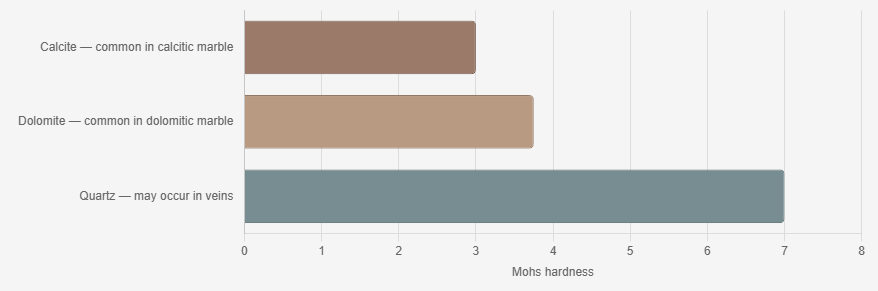 Marble is commonly used for floors, wall cladding, countertops, and decorative details. Polished, honed, and brushed finishes offer different looks and surface textures. Veining reflects variations in mineral composition. The chart shows approximate Mohs hardness values for relevant minerals—not a rating of finished marble, whose properties vary by composition.
Granite and Quartzite: Durable Choices for Busy Spaces
Granite and quartzite suit busy interiors because they combine hard mineral structure with a surface that can handle daily wear. The Natural Stone Institute’s Dimension Stone Design Manual gives typical water-absorption ranges of about 0.05–0.40% for granite and 0.1–0.5% for quartzite. These figures vary by quarry and sample. They are useful screening data, not a guarantee for every slab. Ask for the supplier’s test results, especially for pale stone near sinks or coffee stations.
Both stones resist scratching better than many softer natural materials, but neither is indestructible. ASTM C97/C97M measures absorption, while ASTM C170 tests compressive strength; those results help compare actual samples. A polished granite island can shrug off routine kitchen use, while a honed quartzite entry floor may hide small scuffs better. Still, acidic spills can affect some stones, and grit can dull a finish. That detail gets missed. Sealers may reduce staining, but they do not make stone stain-proof. Test the selected slab, confirm its care requirements, and consider a small sample beside the room’s lighting before committing.
Limestone and Travertine: Warm, Textured Surfaces
Limestone brings a quiet warmth to interiors, with cream, sand, and pale gray tones that soften hard edges. Its fine grain and gentle veining work well on floors, fireplace surrounds, and bathroom walls. In morning light, a honed surface often looks calm rather than glossy. That subtlety is the appeal.
Travertine has a more pronounced texture. Small pores and linear bands can resemble ripples or layers of sediment. Some tiles are filled for a smoother finish; others retain open pits that feel rough beneath the hand. Expect variation. A room may include pieces with noticeably different markings, so inspect several samples together before choosing a layout. Sealing can reduce staining, but it does not make the stone maintenance-free.
Both stones suit warm, natural palettes, though their performance depends on finish, installation, and care. In kitchens or busy entryways, spills should be wiped promptly, especially on lighter surfaces. For a shower, confirm that the selected stone and finish are appropriate for wet conditions, and ask how often resealing may be needed. Stone samples can also look cooler under store lighting than beside your own wood floors. I once underestimated that shift; the installed limestone felt grayer than expected. A sample board near a window can reveal more.
Slate and Onyx: Distinctive Color and Character
Slate and onyx create very different moods. Slate’s layered texture and muted charcoal, green, or rust tones suit floors, fireplaces, and feature walls. Its natural cleft surface adds grip and visual depth, though it can feel uneven underfoot. Onyx is more translucent, with flowing bands that glow under carefully placed lighting. It works well on vanity fronts or small accent panels, but its calcite-rich surface can etch when exposed to acidic cleaners.
The USGS Mineral Commodity Summaries 2024 estimated U.S. dimension-stone sales at $460 million in 2023, compared with a revised $480 million in 2022. These figures cover many stone types, not slate and onyx alone. Still, they show a substantial market for stone surfaces. The mistake is assuming every slab behaves alike. Color shifts in daylight. Veining, porosity, and finish vary from piece to piece, so a small sample may not represent a full installation.
Tips: View the actual slabs in the room’s lighting before choosing. Ask a stone fabricator about sealing and suitable cleaners for that specific stone. For slate flooring, check the finished surface’s slip performance, especially near showers. For onyx, use gentle, pH-neutral care and avoid harsh acids. Test first.
Top Natural Stone Types for Interior Design — Slate and Onyx: Distinctive Color and Character
| Stone Type | Typical Color and Pattern | Surface Character | Interior Design Uses | Care and Selection Notes |
|---|---|---|---|---|
| Charcoal Slate | Dark gray to near-black, sometimes with subtle tonal variation. | Often split-faced with a naturally cleft, layered texture; honed finishes are also available. | Flooring, entryways, fireplace surrounds, and accent walls. | Texture and color vary by source and finish. Use a suitable sealer when recommended, and check the finish for the intended application. |
| Green Slate | Muted sage, olive, or gray-green tones, sometimes with darker mineral markings. | Ranges from relatively even and smooth to distinctly cleft and textured. | Bathroom floors, wall cladding, hearths, and natural, earthy interiors. | Confirm that the selected material is appropriate for wet areas; slip performance depends on its finish and installation. |
| Multicolor Slate | May combine rust, brown, gray, green, and gold tones in irregular patches or bands. | Expressive, naturally varied surface with visible mineral and color variation. | Feature floors, kitchen backsplashes, fireplace surrounds, and statement walls. | View several pieces or a representative layout before selection, as individual tiles can differ noticeably. |
| Banded Onyx | Contrasting bands of cream, amber, brown, or other colors, depending on the stone. | Often polished to highlight its layered pattern and natural translucency. | Backlit feature panels, decorative wall inserts, and statement countertops in low-use areas. | Onyx is relatively soft and can be scratched or etched by acids. Protect it from abrasive contact and acidic spills. |
| Honey Onyx | Warm yellow, gold, cream, and amber tones, often with flowing or cloudy patterns. | Polished surfaces can appear luminous; some slabs transmit light when properly illuminated. | Backlit bars, decorative panels, vanity details, and focal-point surfaces. | Because onyx is a calcium-carbonate stone, acidic cleaners can dull its surface. Use a stone-safe cleaner and test lighting on a sample. |
| Green Onyx | Ranges from pale mint to deeper green, often with cream or white veining. | Typically polished, with translucent areas and noticeable natural variation. | Accent walls, decorative tabletops, vanity surrounds, and carefully placed feature pieces. | Best suited to applications where impact, abrasion, and harsh cleaners are limited; sealing may help resist staining but does not prevent etching. |
| White Onyx | White to ivory, often crossed by soft gray, gold, or beige veins. | Can have a translucent appearance, especially in thinner, backlit panels. | Light-filled feature walls, decorative panels, and low-traffic interior accents. | Inspect the actual slab for veining and translucency. Avoid assuming that a sealer will protect against acid etching or physical damage. |
Note: Natural stone appearance and performance vary by quarry, slab, finish, and installation. Confirm suitability, maintenance requirements, and slip performance with a stone professional before specifying the material.
How to Choose Stone for Each Interior Surface
Natural stone selection starts with how a surface will be used, not just its color. For kitchen counters, granite tolerates daily wear well, while marble offers fine veining but can etch when acidic foods spill. Soapstone has a softer, matte look and can develop scratches over time. Expect variation. Houzz’s 2024 U.S. Kitchen Trends Study found that 42% of renovating homeowners who upgraded countertops chose engineered quartz. That preference is a useful comparison, not proof that quartz suits every home.
For floors, choose dense, slip-conscious stone and ask for the finish to be assessed when wet. Honed or textured limestone and slate can feel less slick than polished stone, though porosity and cleaning needs differ. In bathrooms, check water absorption and sealing requirements before choosing marble or travertine; a shower’s frequent moisture makes maintenance more demanding. Ask the fabricator for care instructions specific to the selected stone and finish.
On walls and fireplace surrounds, lighter travertine or marble can add depth without taking floor-level impact. View the actual slab under your room’s lighting, and compare its veining with nearby cabinets or tile. A small sample cannot show every shift in color. No sample predicts every slab perfectly. That is worth remembering before approval.
FAQS
Which stone works well for a busy kitchen counter?
Granite handles routine wear well. Ask for test results from the exact slab, especially for pale stone near sinks.
Is granite or quartzite completely scratch-proof?
Do sealers make natural stone stain-proof?
What should I check before choosing stone for a shower?
How can I make a stone floor feel less slippery?
What makes travertine look different from limestone?
Why should I view a stone sample at home?
Can one small sample show the full stone variation?
Conclusion
Interior Natural Stone brings lasting character and varied performance to floors, walls, countertops, and other interior surfaces. Each stone has its own combination of color, texture, pattern, and durability, so choosing well means considering both the look of a room and how the surface will be used. Marble is known for expressive veining and a range of finishes, making it a distinctive option for feature areas. Granite and quartzite offer resilient choices for busy spaces, while limestone and travertine add warm tones and tactile texture.
Slate can introduce rich color and a naturally varied appearance, while onyx makes a striking decorative feature through its distinctive patterns and translucence. The best stone depends on the location, expected wear, maintenance preferences, and desired atmosphere. By weighing these practical needs alongside appearance, homeowners can select stone surfaces that complement an interior and serve it well over time.
CATEGORIES
Payment Support
-
Below payment terms accpeted by us :
1.Telegraphic Transfer(TT);
2.Irrevocable L/C at Sight;
3.100% Full Cash;
4.Credit Payment (After Becoming Our Old Client For One Year);
5.You could get prices lower than our costs after US$10,000 is recharged into your VIP card, which is valid in half year.