China Top Bathroom Stone Countertops Manufacturers
Choosing the right bathroom stone countertop manufacturer in China isn’t just about flipping through fancy catalogs or grabbing the lowest quote you find. The market is pretty diverse — you’ve got experienced factories, trading companies, and specialized fabricators, each with their own strengths when it comes to material options, production processes, customization options, and export services. A trustworthy supplier will be upfront about things like where the stone comes from, how thick the slabs are, water absorption rates, sealing treatments, edge profiles, and what’s needed for installation — no vague answers, just clear info.
Bathroom countertops face a lot — moisture, daily cleaning, makeup, and temperature swings. That’s why it’s crucial to work with experienced manufacturers who usually provide samples, digital drawings, quality checks, and sturdy packaging. They should be able to discuss different materials like quartz, marble, granite, sintered stone, or engineered surfaces based on what your project needs. Before they start production, it’s also smart to double-check tolerances, basin cutouts, backsplash sizes, and color variations — those little details really matter.
Don’t forget to verify who you’re dealing with. Ask for factory photos, recent project references, inspection reports, and relevant certifications — the more proof, the better. Conducting independent inspections can help confirm if everything’s up to snuff, from dimensions and surface quality to packaging strength and order consistency. A good supplier will be honest about lead times and will explain how they handle damaged pieces. Remember, trust isn’t built on empty promises — it’s built on real evidence.
Of course, no manufacturer is perfect. Natural stone can vary from batch to batch, and even with careful work, you might notice some slight shade differences. That’s normal, and it’s worth having an honest chat about it upfront. This guide is based on real hands-on experience, looking at factors like technical skills, communication, customization options, and how reliable after-sales support is, rather than just focusing on the lowest price. After all, a countertop that arrives intact, fits perfectly, and works well over time can save you headaches and extra costs with replacements or delays. That’s the standard worth aiming for.

Table of Contents [Hide]
1 Bathroom Stone Countertops: Definition, Uses, and Key Features
2 China’s Bathroom Stone Countertop Manufacturing Industry
3 Main Stone Materials Used for Bathroom Countertops
4 How Chinese Manufacturers Design and Produce Stone Countertops
5 Quality Standards and Inspection Practices in China
6 Customization, Finishes, Sizes, and Installation Support
7 How to Evaluate and Select a Reliable Chinese Manufacturer
Bathroom Stone Countertops: Definition, Uses, and Key Features
Bathroom stone countertops are solid surfaces cut and finished for vanities, sink units, and storage cabinets. They may use granite, marble, quartz, or sintered stone. Each material behaves differently in a humid bathroom.
A well-made countertop resists daily splashes, stains, and moderate heat from styling tools. Low water absorption helps protect the cabinet below. Polished surfaces reflect light, while honed finishes create a softer, less slippery visual effect. Edge profiles also matter. A rounded edge feels safer and reduces sharp contact near narrow walkways.
From practical project experience, accurate measurements are essential before fabrication. Wall corners are rarely perfectly square. Small errors can create visible gaps around the basin or backsplash. Natural stone also shows color variation, veins, and tiny mineral marks. That is not always a defect. It should be reviewed before cutting.
Reliable manufacturers usually provide material samples, slab photos, technical data, and clear inspection standards. Buyers should check thickness, flatness, polishing consistency, cutout dimensions, and packaging protection. Sealed stone still needs gentle cleaning. No countertop is completely maintenance-free. Dark polished stone may reveal water spots more easily, while light marble can react to acidic cleaners. Careful material selection often matters more than appearance alone.
China Top Bathroom Stone Countertops Manufacturers - Bathroom Stone Countertops: Definition, Uses, and Key Features
| Data Dimension | Category or Specification | Verified General Information | Practical Consideration |
|---|---|---|---|
| Definition | Bathroom stone countertop | A horizontal bathroom surface manufactured from natural stone or engineered stone, usually fabricated with openings for a basin, faucet, and plumbing connections. | The selected material should suit moisture, cleaning, and installation conditions. |
| Primary Uses | Residential bathrooms | Used for vanity tops, integrated or vessel-sink installations, backsplash arrangements, and storage cabinet surfaces. | Confirm cabinet dimensions and sink position before fabrication. |
| Primary Uses | Hotels and commercial washrooms | Suitable for guest bathrooms, office washrooms, retail facilities, and other interior wet-area applications. | Prioritize stain resistance, repeatable production, easy cleaning, and replacement availability. |
| Common Materials | Granite | Natural igneous stone with high hardness and good resistance to heat and abrasion. Many varieties require periodic sealing. | Natural pattern variation should be accepted as part of the material character. |
| Common Materials | Marble | Natural metamorphic stone valued for veining and appearance. It is more susceptible to scratching and acid etching than many granites. | Use pH-neutral cleaners and consider sealing according to the stone supplier’s instructions. |
| Common Materials | Quartz engineered stone | A factory-made surface composed primarily of stone aggregate and binder. It offers consistent patterns, low routine maintenance, and non-porous performance when properly manufactured. | Avoid prolonged exposure to strong chemicals and excessive heat. |
| Common Materials | Porcelain or sintered stone | A dense, manufactured ceramic-based surface with low water absorption and strong resistance to staining, ultraviolet exposure, and many household chemicals. | Professional cutting and edge fabrication are recommended because the slab can be brittle during processing. |
| Typical Thickness | Slab thickness | Common commercial thicknesses include approximately 12 mm, 20 mm, and 30 mm, depending on material type and fabrication requirements. | The support structure, edge profile, and finished appearance must be designed for the selected thickness. |
| Edge Profiles | Common edge treatments | Popular options include eased, pencil-round, bevelled, bullnose, and laminated edges. | More complex profiles generally require additional fabrication time and cost. |
| Surface Performance | Moisture resistance | Engineered quartz and porcelain generally have low water absorption. Natural stones vary in porosity and may require sealing. | Keep joints and wall connections properly sealed to prevent water intrusion into cabinets. |
| Surface Performance | Stain resistance | Dense, non-porous surfaces are typically easier to keep free from cosmetic products, soap residue, and toothpaste stains. | Wipe spills promptly and follow the material-specific cleaning instructions. |
| Fabrication Options | Sink and faucet cut-outs | Fabrication may include under-mount, top-mount, or vessel-sink cut-outs, as well as one-hole or multi-hole faucet drilling. | Use the exact sink and faucet templates to reduce installation errors. |
| Maintenance | Routine cleaning | Use a soft cloth or non-abrasive sponge with warm water and a mild, pH-neutral cleaner. | Avoid abrasive powders, harsh acids, and unapproved solvent-based products. |
| Quality Inspection | Key inspection points | Check slab color and pattern, thickness, dimensions, cut-out accuracy, edge finishing, surface defects, packaging, and moisture protection. | Approve shop drawings and a physical sample when appearance consistency is important. |
| Selection Criteria | Project requirements | Compare material performance, available slab sizes, fabrication capability, tolerances, packaging, lead time, documentation, and after-sales support. | Select a qualified fabricator that can provide clear technical specifications and installation guidance. |
China’s Bathroom Stone Countertop Manufacturing Industry
China Top Bathroom Stone Countertops Manufacturers
China’s Bathroom Stone Countertop Manufacturing Industry is moving toward engineered quartz, sintered stone, and digitally cut natural stone. Grand View Research valued the global engineered stone market at about USD 23.7 billion in 2023, with continued growth expected through 2030. China remains important because its factories combine slab processing, CNC cutting, edge polishing, and export packaging in one supply chain.
Factory capability matters more than attractive showroom samples.
During inspections, buyers should check water absorption, flatness, vein alignment, edge strength, and sink cutout accuracy. A two-millimeter error can create visible gaps around a basin. EN 14617-1 and ASTM C97 test methods provide useful references, although the correct standard depends on the material. Reports from the China Stone Material Association also emphasize cleaner processing and higher-value stone products, not only greater output.
Small details reveal manufacturing discipline.Each slab should carry a batch code. Wooden crates need moisture protection and reinforced corners. Digital templates should be approved before cutting.
It sounds basic.
China Customs statistics for stone and agglomerated materials show the scale of international trade, but customs categories do not isolate bathroom countertops. This limitation deserves attention.
Buyers should request recent test reports, inspection photos, dimensional records, and shipment references instead of trusting market rankings alone. Some manufacturers still rely heavily on manual polishing. Results may vary between batches. Careful sampling remains necessary.
Main Stone Materials Used for Bathroom Countertops
Natural stone remains a practical choice for bathroom countertops, but each material behaves differently.
Granite offers strong resistance to scratches, heat, and daily wear. Its mineral patterns can hide small water marks, although some lighter slabs need periodic sealing.
Marble creates a refined appearance with visible veining. However, acidic cleaners may etch its surface and leave dull spots. That vulnerability is easy to underestimate.
Quartzite combines a natural stone appearance with excellent hardness. It suits busy family bathrooms, especially when the surface receives proper sealing.
Engineered quartz is not natural stone, but it provides consistent colors and low routine maintenance. It can still suffer from heat damage, so hot styling tools should not rest directly on it.
Limestone and travertine bring soft, earthy textures. Their pores require careful sealing and prompt cleaning.
Material selection should consider water exposure, cleaning habits, edge design, and installation quality.
A honed finish may reduce glare, yet it can show oils more easily than a polished finish. Large slabs create fewer seams, but transport and cutting require experienced fabricators.
Sink openings must be measured precisely around plumbing fixtures. No material is flawless. Even durable stone can disappoint when the sealant, support cabinet, or drainage design is overlooked.
A small sample tested under bathroom lighting often reveals more than a catalog photograph.
How Chinese Manufacturers Design and Produce Stone Countertops
China Top Bathroom Stone Countertops Manufacturers
How Chinese Manufacturers Design and Produce Stone Countertops
Chinese bathroom countertop manufacturers usually begin with a digital drawing and a detailed room survey. Designers check wall angles, drain positions, basin sizes, and cabinet measurements. They select marble, granite, quartz, or engineered stone based on moisture exposure and maintenance needs. A good designer also studies vein direction. It affects how the finished surface looks around cutouts and edges.
Production combines skilled handwork with CNC equipment. Workers inspect slabs for cracks, color movement, and hidden pits before cutting. CNC machines create precise openings for basins and taps. Craftspeople then polish the edges, often by hand, to achieve a consistent shine. Quality teams measure thickness and check flatness under bright lights. However, natural stone is never perfectly uniform. Small shade differences can remain, even after careful inspection. That limitation deserves clear discussion before approval.
Tips: Request a shop drawing before production. Confirm edge profiles, splashback heights, drainage space, and tolerances. Ask for slab photos with marked cutting zones. A sample finish can reveal unwanted gloss or roughness. Packaging also matters. Foam corners, reinforced crates, and moisture protection reduce transport damage. I have found that rushed measurements cause more problems than complex fabrication. Allow time for a final inspection, because one overlooked millimeter can affect installation.
Quality Standards and Inspection Practices in China
China’s leading bathroom stone countertop manufacturers usually follow documented quality controls from slab selection to final packing. Inspectors check stone type, color consistency, thickness, water absorption, and flexural strength. These results should match agreed project specifications, not vague promises.
A practical inspection starts with approved samples. Compare each production slab with the signed sample under neutral lighting. Check scratches, resin marks, pinholes, edge chips, and uneven polishing. Measure length, width, thickness, sink openings, and backsplash angles with calibrated tools. A clean surface can still hide weak edges. Factory records, batch numbers, moisture readings, and photographs improve traceability. Third-party laboratory reports add confidence, but they should be recent and linked to the actual material batch.
Tips: Ask for a pre-production sample, a dimensional inspection report, and packing photographs. Confirm the inspection date. A small mock-up can expose installation problems early. Do not rely only on certificates.
One weakness remains common: visual grading can vary between inspectors. Clear acceptance limits reduce arguments, although they cannot remove every judgment call. Check the finished countertop again before loading, especially around cutouts and polished corners. Proper foam protection and vertical support help prevent damage during transport.
Customization, Finishes, Sizes, and Installation Support
China’s leading bathroom stone countertop manufacturers provide practical customization for residential and hospitality projects. Experienced fabricators can adjust vanity tops to wall dimensions, basin openings, faucet positions, and drainage layouts. Quartz, marble, granite, and sintered stone offer different performance and visual qualities. Quartz gives consistent color and low maintenance. Natural stone adds unique veining, but requires careful sealing.
Finishes strongly influence daily use. Polished surfaces reflect light and clean easily, while honed finishes create a softer, matte appearance. Leathered textures can improve visual depth, though they may need more careful cleaning. Common sizes include compact single-vanity tops, double-sink layouts, and custom lengths for irregular bathrooms. Edge profiles can also be selected, from simple eased edges to more decorative shapes. Exact measurements matter. Small errors can create expensive site problems.
Tips: Send a measured drawing, photos, basin specifications, and faucet details before production. Confirm slab thickness, edge treatment, color variation, packaging, and delivery protection in writing. Ask for a physical sample when possible. Samples are useful, but they cannot show every natural vein. Installation support may include shop drawings, installation guides, cutout confirmation, and remote technical assistance. Some suppliers can coordinate local installation partners, but responsibilities should be clearly defined. A perfect installation plan is uncommon. Recheck wall levels and cabinet support before delivery. Relaxed assumptions often cause avoidable delays.
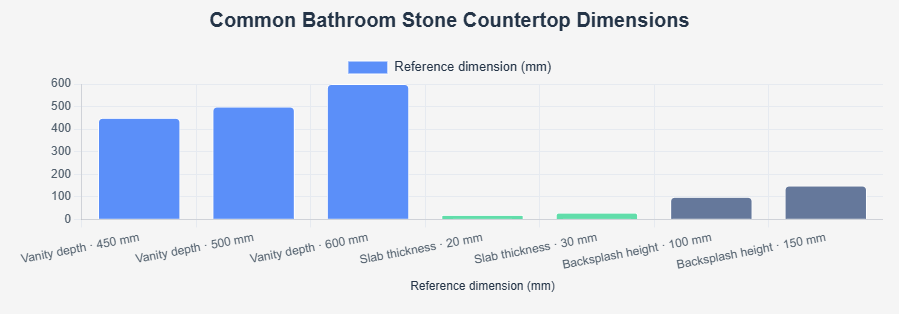
China Bathroom Stone Countertops: Common Reference Dimensions
Custom stone countertop manufacturers commonly produce vanity tops in 450 mm, 500 mm, and 600 mm depths. Typical slab thicknesses are 20 mm and 30 mm, while standard backsplash heights often range from 100 mm to 150 mm. Final dimensions should be confirmed through the approved shop drawing and site measurements.
Customization may include polished, honed, or leathered finishes, integrated or under-mount sink openings, edge profiles, faucet holes, backsplash pieces, packaging, delivery coordination, and installation support.
How to Evaluate and Select a Reliable Chinese Manufacturer
Selecting a reliable Chinese bathroom stone countertop manufacturer requires more than attractive photos. China is listed among the world’s major dimension-stone producers in the U.S. Geological Survey’s 2024 Mineral Commodity Summaries. Production capacity is therefore broad, but quality can vary sharply between factories.
Request the company’s legal registration, plant address, export history, and recent project references. Ask for ISO 9001 certification, but do not treat it as proof of perfect stone. The 2023 ISO Survey identifies ISO 9001 as the most widely adopted quality-management standard worldwide. Still, certificates need verification. Check their testing records for water absorption, flexural strength, stain resistance, and dimensional tolerance. Ask whether results apply to your exact stone batch.
Inspect a live video of slab cutting, edge polishing, drilling, and final packing. Look for clean sink openings, consistent veining, protected corners, and dry wooden crates. A dependable supplier should explain quarry origin, slab grading, replacement policy, and inspection timing without vague promises. Request a pre-shipment inspection by an independent agency when the order is large. This costs more, but one cracked vanity top can cost far more in delays.
Do not judge reliability from the lowest quotation. Very low prices may hide thin slabs, mixed lots, weak packaging, or unclear sealant specifications. I would also order a small sample batch first. That step feels slow. It is often necessary. Recheck color under bathroom lighting, because showroom lighting can conceal shade differences. Supplier communication, corrective action, and documented measurements matter as much as polished surfaces.
FAQS
Which stone materials work well for bathroom countertops?
Granite resists scratches, heat, and everyday wear. Quartzite offers natural patterns and strong hardness. Engineered quartz provides consistent colors and simple routine care. Marble, limestone, and travertine look refined but need more careful maintenance.
What problems can marble develop in a bathroom?
Does engineered quartz tolerate hot styling tools?
How should porous stone be maintained?
What measurements should a manufacturer confirm before production?
How can buyers check countertop production quality?
What should reliable manufacturers provide before an order?
Why is packaging important for stone countertops?
Conclusion
Bathroom Stone Countertops are durable, attractive surfaces designed for bathroom vanities, washbasins, and related applications. They combine practical performance with design flexibility, offering resistance to moisture, daily wear, stains, and temperature changes when properly selected and maintained. Common materials include natural marble, granite, quartzite, engineered quartz, and other stone-based surfaces, each providing different patterns, strengths, maintenance requirements, and price levels.
China has developed a comprehensive Bathroom Stone Countertops manufacturing industry supported by advanced processing equipment, skilled workers, and organized quality-control systems. Manufacturers typically manage material selection, cutting, edge shaping, polishing, drilling, sealing, and final inspection. Buyers can request customized colors, dimensions, basin openings, edge profiles, surface finishes, and packaging, as well as installation guidance or technical support. When evaluating a reliable Chinese manufacturer, it is important to review material quality, production capabilities, inspection procedures, customization accuracy, communication, delivery performance, and after-sales service. Clear drawings, samples, specifications, and acceptance standards can help ensure consistent results.
CATEGORIES
Payment Support
-
Below payment terms accpeted by us :
1.Telegraphic Transfer(TT);
2.Irrevocable L/C at Sight;
3.100% Full Cash;
4.Credit Payment (After Becoming Our Old Client For One Year);
5.You could get prices lower than our costs after US$10,000 is recharged into your VIP card, which is valid in half year.