China Best Stone Customized Design Manufacturer?
China Best Stone Customized Design Manufacturer? Honestly, that question deserves way more than a quick scan for the lowest price.
Stone Customized Design is now showing up in hotels, villas, restaurants, and high-end retail interiors. Grand View Research put the global natural stone market at around USD 33 billion in 2023, and its report expects steady growth through 2030. Meanwhile, the Global Stone Industry Report points to stronger demand for customized slabs, waterjet patterns, and digitally planned surfaces.
The details? They matter. A lot.
A reliable Chinese manufacturer should be able to show you quarry sources, slab inspection records, moisture testing, and photos from completed projects. Buyers should also look at edge profiles, color tolerances, packaging methods, and replacement policies. Those things often decide whether a beautiful sample turns into a successful installation—or a headache.
Michelangelo once said, “I saw the angel in the marble and carved until I set him free.” That line still captures the craft. Good design reveals the stone’s character instead of trying to hide every variation.
Experienced manufacturers combine CNC cutting, hand finishing, shop drawings, and installation feedback. But technology can’t fix bad material selection. And that’s where plenty of projects get expensive.
The Natural Stone Institute stresses fabrication quality, maintenance planning, and responsible material selection in its professional guidance. Those principles matter a lot for Chinese export projects. Sustainability claims, though, shouldn’t be accepted without documentation. Some suppliers call stone “green” without publishing any evidence about quarrying, transport, or processing.
China offers broad production capacity and competitive customization. Still, factories aren’t all the same. A careful buyer should compare technical drawings, tolerances, certifications, lead times, and communication quality.
This guide evaluates manufacturers by those practical standards. It focuses on design ability, manufacturing experience, quality control, and verifiable project performance. Because not every impressive showroom tells the full story.

Table of Contents [Hide]
1 Definition of a China-Based Stone Customized Design Manufacturer
2 Key Services Offered by Custom Stone Design Manufacturers in China
3 Stone Materials and Finishes Available for Custom Projects
4 How the Customized Stone Design and Production Process Works
5 Quality Standards and Manufacturing Capabilities to Evaluate
6 Applications of Custom Stone Products in Architecture and Interiors
Definition of a China-Based Stone Customized Design Manufacturer
A China-based stone customized design manufacturer is more than a supplier of slabs. It combines material sourcing, design development, fabrication, quality control, and export coordination in one working system. The team turns drawings, room measurements, and surface preferences into practical stone components for homes, hotels, offices, and public interiors.
Experienced manufacturers usually maintain relationships with quarries and inspect blocks before production. They assess veining, density, water absorption, color variation, and possible cracks. Designers then prepare shop drawings, edge profiles, cutouts, and installation references. Digital templates help reduce errors around sinks, stairs, fireplaces, and curved walls. Still, stone is natural. Perfect uniformity is not always realistic.
A dependable factory explains these limits early. It shares samples, production photographs, inspection records, packing details, and clear tolerance standards. Technical staff should confirm dimensions before cutting, while inspectors check polishing, joints, labels, and crate protection. Communication matters as much as machinery. A delayed drawing approval can affect the entire schedule.
The definition also includes customization capability. This may involve special finishes, waterjet patterns, book-matched panels, unusual thicknesses, or project-specific packaging. Yet customization should not mean accepting every request without reflection. Some designs look attractive on paper but create weak corners, difficult maintenance, or excessive waste. A professional manufacturer proposes safer alternatives and admits when a detail needs revision. That honesty builds practical trust.
Key Services Offered by Custom Stone Design Manufacturers in China
Custom stone design manufacturers in China often support projects from the first sketch to final shipment. Their service begins with design consultation. Experienced teams review dimensions, usage, color, grain direction, and installation conditions. They can develop CAD drawings, 3D visuals, and stone layouts for residential, hospitality, and commercial spaces. This review can reveal weak joints, difficult edges, or unrealistic details before production. Not every attractive drawing is practical.
Material sourcing is another core service. Manufacturers may recommend marble, granite, quartzite, limestone, or engineered stone based on performance requirements. They check slabs for tone, fissures, thickness, and surface consistency. Clients can request physical samples and approval panels before fabrication.
Custom cutting includes waterjet patterns, CNC carving, edge profiles, sinks, tables, wall panels, and stair components. Skilled technicians translate digital files into shop drawings. Small measurement errors still happen, so confirmed site dimensions matter.
Quality control usually covers slab inspection, template verification, polishing, assembly, and final packing. Reliable suppliers label each piece and provide installation drawings, care guidance, and replacement records. Some coordinate container loading and offer remote installation support. Clear communication is essential when colors vary naturally between slabs. A sample cannot show everything. Buyers should confirm tolerances, lead times, packing standards, and inspection procedures in writing. A capable manufacturer documents decisions and responds when a detail needs correction. That accountability builds trust, although no workshop can remove every project risk.
Stone Materials and Finishes Available for Custom Projects
China Best Stone Customized Design Manufacturer?
Custom stone projects need more than attractive colors. They require suitable materials, accurate fabrication, and clear technical judgment. Marble brings natural veining and a refined appearance. Granite offers strong performance for kitchens, façades, and heavily used areas. Quartzite combines distinctive patterns with good hardness. Limestone and travertine create softer, warmer surfaces, but they need careful sealing and maintenance.
Small samples matter. A polished finish reflects light and highlights movement in the stone. Honed surfaces feel calm and hide minor scratches better. Leathered finishes add texture without looking overly rough. Brushed, flamed, and sandblasted options can improve grip outdoors. However, finish performance changes with the stone itself. A flamed surface may look uneven on some varieties. That detail should be tested, not assumed.
Reliable custom production starts with verified slabs, shop drawings, and full-size samples. Experienced fabricators check vein direction, thickness, edge profiles, cutouts, and installation tolerances. They should also review water absorption, stain resistance, UV exposure, and slip requirements. Digital drawings reduce confusion, but they cannot replace physical inspection. Natural stone always contains variation. That is part of its value, and sometimes part of the difficulty. One panel may differ from another more than expected. A careful supplier explains this before cutting, documents inspections, and protects finished pieces with suitable packaging. The best result is not always the most expensive stone; it is the material and finish that fit the space, use, and maintenance plan.
Typical Mohs Hardness of Stone Materials for Custom Projects
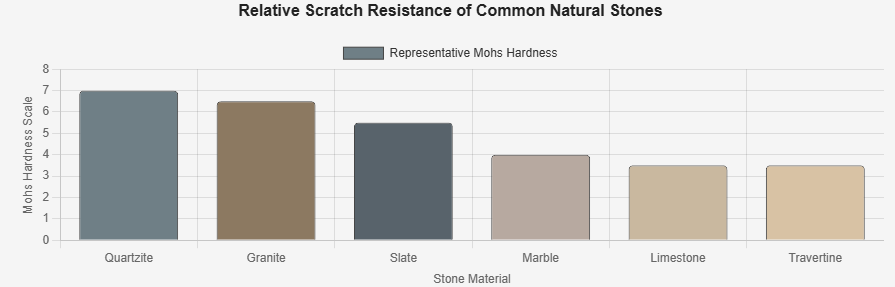
The chart uses representative midpoint values from commonly reported Mohs hardness ranges. Quartzite and granite are generally selected for high-wear surfaces, while marble, limestone, and travertine are often chosen for their distinctive veining and softer visual character. Available custom finishes may include polished, honed, leathered, brushed, flamed, sandblasted, and natural cleft surfaces, depending on the stone type and project requirements.
How the Customized Stone Design and Production Process Works
China Best Stone Customized Design Manufacturer?
Customized stone work starts with a measurable brief, not a beautiful picture. The client confirms dimensions, stone type, finish, edge profile, installation location, and budget. A 3D drawing then reveals joints, veining direction, and possible weight problems. Industry estimates vary, but Grand View Research valued the global natural stone market at roughly USD 50 billion in 2023, with annual growth near 4%. That scale increases demand for accurate customization.
Material inspection comes next. Technicians check slabs under natural and artificial light. They record thickness, water absorption, cracks, color movement, and usable areas. A small vein can change the whole composition. The CAD team nests each component before CNC cutting, reducing waste and protecting the design. Experienced factories also test polishing samples before mass production. ASTM standards and supplier inspection records support more reliable quality decisions. Still, digital images cannot fully show natural variation.
The production line usually includes cutting, edge shaping, drilling, polishing, dry assembly, and final inspection. Workers compare every piece with approved drawings. They also check flatness, hole positions, and visible seams. Packaging follows the installation sequence, which reduces confusion on site. Some errors remain possible. A first layout is rarely perfect. Better teams welcome revision before cutting. That habit costs time, but it prevents expensive replacement and makes customized stone design more dependable.
Quality Standards and Manufacturing Capabilities to Evaluate
China Best Stone Customized Design Manufacturer?
Quality Standards and Manufacturing Capabilities to Evaluate
A customized stone manufacturer should prove quality before showing polished samples. The U.S. Geological Survey reported about 1.6 million metric tons of U.S. dimension stone production in 2023. This scale increases the need for consistent testing and traceable sourcing. Ask for recent test reports, not only showroom photographs.
For natural stone, ASTM C97 measures absorption and bulk specific gravity. ASTM C170 evaluates compressive strength, while ASTM C880 examines flexural strength. European projects may reference EN 1469 for stone cladding. A capable factory should connect each result to a quarry block, production batch, and inspection date. Check slab thickness, flatness, edge finishing, color variation, and water staining under practical lighting. Small details matter.
Manufacturing capability is visible in the workshop. Look for calibrated bridge saws, CNC profiling, resin treatment, polishing control, and dry-fitting procedures. Experienced teams also inspect crate protection and moisture barriers before shipment. No factory is flawless. I would question any supplier promising zero variation in natural stone. A stronger manufacturer explains acceptable limits and records every correction. The Global Natural Stone Association’s industry guidance also emphasizes installation conditions, because even excellent slabs can fail on weak substrates or poor drainage. A supplier’s sample may look perfect. Production may not. Require a pilot batch, independent inspection, and written acceptance criteria before approving the full order.
Applications of Custom Stone Products in Architecture and Interiors
Custom stone products bring measured character to architecture and interiors. They adapt to walls, floors, façades, kitchens, hotels, and public spaces.
In practice, a customized stone manufacturer begins with drawings, site dimensions, and material samples. Large lobby walls may require book-matched slabs with carefully aligned veining. Bathroom vanities need precise cutouts, polished edges, and moisture-resistant installation details. Exterior cladding demands suitable thickness, anchors, drainage gaps, and resistance to local weather. Small tolerances matter. A two-millimeter error can disturb an entire visual line.
Interior designers often use stone for reception desks, staircases, fireplace surrounds, shelving, and feature walls. CNC cutting can create curved counters and complex inlays, while hand finishing softens visible edges. Each application needs a different surface treatment. Honed stone reduces glare, but polished surfaces can highlight fingerprints and scratches. Textured finishes improve visual depth, although cleaning may become harder.
Reliable production depends on technical communication and inspection. I have found that physical samples reveal differences that drawings cannot show. Color variation is natural, yet it must remain within an agreed range. Not every ambitious pattern works. Sometimes the quieter option performs better. A dependable supplier should confirm shop drawings, check dry layouts, protect finished surfaces, and document quality before shipment. Mistakes still happen, especially when site conditions change, so installation teams need clear instructions and practical flexibility.
China Best Stone Customized Design Manufacturer? - Applications of Custom Stone Products in Architecture and Interiors
| Application Area | Recommended Stone Options | Common Custom Products | Key Performance Requirements | Typical Finishes | Important Design Considerations |
|---|---|---|---|---|---|
| Building Facades | Granite, limestone, sandstone, and engineered stone suitable for exterior use | Cladding panels, ventilated facade modules, corner pieces, window surrounds, and coping stones | Weather resistance, low water absorption, dimensional stability, secure anchoring, and resistance to freeze-thaw conditions where applicable | Flamed, bush-hammered, sandblasted, honed, and natural split | Panel size, weight, joint layout, drainage, anchoring system, thermal movement, and local building regulations |
| Interior Flooring | Granite, porcelain stone, quartzite, marble, and dense limestone | Floor tiles, large-format slabs, medallions, borders, stair treads, and transition pieces | Abrasion resistance, slip resistance, adequate thickness, flatness, stain resistance, and ease of maintenance | Polished, honed, leathered, brushed, flamed, and textured | Traffic level, wet-area requirements, installation method, grout width, shade variation, and directional veining |
| Kitchens and Bathrooms | Granite, quartzite, marble, sintered stone, engineered quartz, and porcelain | Countertops, vanity tops, splashbacks, shower panels, sink cutouts, and integrated drainboards | Low porosity, resistance to heat and stains, hygienic surface, edge strength, and accurate cutouts | Polished, honed, suede, matte, and textured | Slab matching, seam placement, overhang support, appliance openings, radius corners, and sealing requirements for porous stones |
| Staircases and Steps | Granite, marble, limestone, quartzite, and engineered stone | Treads, risers, landings, stringer cladding, nosings, and balustrade components | Load-bearing capacity, slip resistance, edge durability, consistent thickness, and precise tolerances | Honed, flamed, bush-hammered, brushed, and polished with safety grooves | Step dimensions, nosing projection, anti-slip detailing, structural support, lighting integration, and code compliance |
| Feature Walls and Interior Panels | Marble, onyx, travertine, slate, limestone, and textured natural stone | Bookmatched panels, 3D wall panels, fireplace surrounds, decorative strips, and backlit stone panels | Visual consistency, panel stability, secure fixing, manageable weight, and resistance to indoor humidity | Polished, honed, brushed, split-face, chiseled, fluted, and waterjet-textured | Vein direction, slab sequencing, lighting temperature, substrate preparation, access for installation, and maintenance plan |
| Hospitality and Commercial Interiors | Granite, marble, quartzite, porcelain, engineered quartz, and durable limestone | Reception desks, bar counters, tabletops, wall bases, elevator surrounds, and custom furniture components | High traffic durability, stain resistance, cleanability, impact resistance, and repeatable production quality | Polished, honed, leathered, matte, fluted, and CNC-carved | Guest safety, accessibility, edge protection, coordination with lighting and metalwork, replacement planning, and installation scheduling |
| Outdoor Landscaping | Granite, sandstone, slate, dense limestone, and concrete-based architectural stone | Paving, pool coping, retaining wall caps, benches, planters, steps, fountains, and outdoor sculptures | Slip resistance, frost resistance where required, UV stability, drainage compatibility, and resistance to thermal cycling | Flamed, bush-hammered, tumbled, natural cleft, sandblasted, and split-face | Surface drainage, pool chemical exposure, freeze-thaw climate, edge profiles, installation bedding, and safe walking zones |
| Custom Stone Fabrication Workflow | Material selected according to application, climate, design intent, and maintenance expectations | CAD drawings, CNC cutting, waterjet patterns, edge profiling, drilling, carving, assembly, and numbered installation sets | Accurate shop drawings, approved samples, dimensional inspection, packaging protection, traceability, and coordinated installation | Specified according to the project’s visual, tactile, and safety requirements | Confirm stone type, thickness, tolerances, finish, edge detail, quantity, drawings, quality criteria, and delivery sequence before production |
Note: Stone suitability depends on the specific material, finish, climate, installation system, and applicable project standards. Final selection should be verified through technical data, samples, and project-specific testing.
FAQS
What does a customized stone design manufacturer provide?
It combines material sourcing, design development, fabrication, inspection, and export coordination. The service goes beyond selling slabs. Teams convert drawings and measurements into finished stone components.
How does a manufacturer control natural stone variation?
What quality documents should buyers request?
Which manufacturing abilities matter for customized projects?
What applications suit customized stone products?
Why are physical samples important?
How can buyers reduce production mistakes?
Can every unusual stone design be produced safely?
Conclusion
A China-based stone customized design manufacturer combines material expertise, creative planning, precision fabrication, and project support to deliver stone solutions tailored to specific architectural and interior requirements. Its services may include concept development, technical drawings, material selection, sampling, CNC cutting, edge shaping, surface treatment, quality inspection, packaging, and delivery coordination. With access to marble, granite, quartzite, limestone, travertine, and engineered stone, manufacturers can provide finishes such as polished, honed, brushed, flamed, leathered, or textured surfaces.
The Stone Customized Design process usually begins with project requirements and measurements, followed by design confirmation, material approval, prototyping, production, and final inspection. When evaluating a manufacturer, buyers should consider dimensional accuracy, color consistency, workmanship, production capacity, quality control procedures, packaging standards, and communication efficiency. Custom stone products can be used for façades, flooring, staircases, countertops, wall panels, bathrooms, furniture elements, reception areas, and other residential, commercial, hospitality, and public spaces.
CATEGORIES
Payment Support
-
Below payment terms accpeted by us :
1.Telegraphic Transfer(TT);
2.Irrevocable L/C at Sight;
3.100% Full Cash;
4.Credit Payment (After Becoming Our Old Client For One Year);
5.You could get prices lower than our costs after US$10,000 is recharged into your VIP card, which is valid in half year.