Top 10 Limestone Suppliers in China for Global Buyers
Honestly, picking a reliable limestone supplier in China isn't just about comparing prices or scrolling through fancy project photos. You've got to dig into things like product consistency, how much they can process, their packing methods, and how they communicate—before you even think about placing an order.
So, if you're sourcing from China for architectural, landscaping, or construction projects, this guide covers ten suppliers worth checking out. The profiles should help you whittle down your options—but honestly, a list like this can only do so much. You'll still want to verify things yourself. Also, what works depends entirely on your project. For example, a pale, honed tile might look great on an interior wall, but if you're paving an outdoor area, you need to pay way more attention to thickness, finish, and slip resistance. Hey, when you're talking to suppliers, make sure you ask for recent production photos, technical data, sample pieces, and of course, get the full scoop on where the quarry is. Then, double-check that the sample you got actually matches what they'll send in bulk. Sounds like a no-brainer, right? But you'd be surprised how often things don't line up.
So when you're really getting down to evaluating a supplier, it's not just about the big talk. You've got to ask some practical questions, you know? Like, can they actually deliver consistent dimensions every time? And how do they protect those slabs from getting chipped edges during shipping? What about the inspection steps before packing – who checks what? Photos with dates and written answers are way more convincing than just vague promises. And don't forget to double-check their current export capabilities and the paperwork they have, because those things change sometimes. Honestly, it's the small checks that really count.
Hey, so the suppliers we've listed here are just a starting point—definitely not an automatic endorsement. Rankings? They might not match your priorities at all, and honestly, public info can be incomplete. So think of this comparison as a shortlist to get you going. Then go ahead and ask for quotes, and double-check their claims yourself. Oh, and about limestone: it naturally varies in color and texture, even within the same source. So a little uncertainty is totally normal—but if something's unexplained, that's a red flag.

Table of Contents [Hide]
1 Limestone in China: Types, Properties, and Main Uses
2 China’s Limestone Industry and Key Production Regions
3 How to Evaluate Chinese Limestone Suppliers
4 Top 10 Limestone Suppliers in China for Global Buyers
5 Comparing Supplier Products, Quality Standards, and Export Capabilities
6 Sourcing, Shipping, and Import Considerations for Global Buyers
Limestone in China: Types, Properties, and Main Uses
Limestone from China is not one uniform material. Buyers may encounter high-calcium limestone, dolomitic limestone, and fossil-rich varieties, each with different mineral content and appearance. High-calcium stone is valued for its calcium carbonate content, while dolomitic material also contains magnesium. Fossil fragments and fine veins can create visible patterns. Some deposits are dense and pale; others are porous or show uneven color. Looks can mislead.
Limestone is relatively soft, typically around 3 on the Mohs scale, and reacts with dilute acid. Its performance depends on chemistry, moisture, particle size, and the intended process. Small differences matter. Cement and lime production use limestone as a key raw material, while steelmaking may use it as a flux. Crushed grades also serve as road base and construction aggregate. Agricultural applications can help adjust soil acidity, subject to local soil testing. For procurement, request recent chemical analyses and particle-size data, and confirm sampling methods before comparing offers. A bright surface alone does not prove high purity. Even standard grades can vary between quarry faces, a detail that is easy to underestimate.
Limestone in China: Typical Bulk Density Ranges by Material Type
Approximate reference ranges for common limestone materials; actual values vary with porosity and mineral composition.
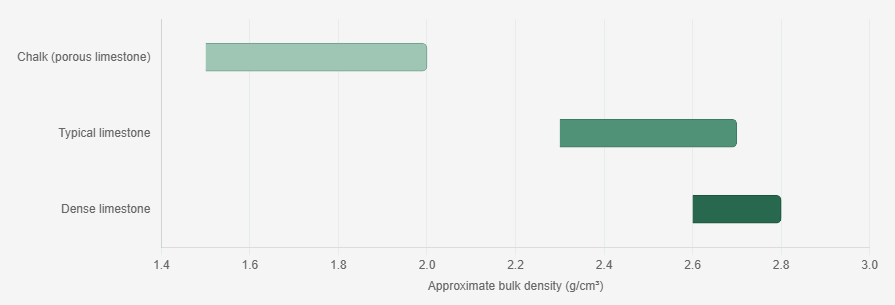
About the chart: Chalk is generally more porous and less dense than typical or dense limestone. Limestone is widely used as cement feedstock, construction aggregate, and building stone. These ranges are indicative material references, not product specifications.
China’s Limestone Industry and Key Production Regions
China’s limestone industry is shaped by geology, cement demand, and transport costs. The USGS Mineral Commodity Summaries 2024 estimates China produced about 2.0 billion tonnes of cement in 2023, illustrating the scale of downstream demand. Cement output is not a direct measure of limestone production; quarry yields and blended materials vary. The scale is immense.
Quarrying and processing are concentrated in provinces such as Anhui, Shandong, Guangdong, Guangxi, and Sichuan. These regions combine carbonate formations with cement plants and established transport links. Anhui’s Yangtze corridor can support bulk shipping, while Guangxi’s karst terrain contains extensive carbonate rock. However, local geology and environmental conditions differ. A province-wide label is not enough; verify the specific quarry and transport route.
Tips: Request the quarry location, CaCO₃ assay, MgO content, moisture level, particle-size distribution, and recent independent test results. Confirm whether stated capacity refers to raw stone or saleable material. Freight can change the real cost. Public statistics may group limestone with other non-metallic minerals, so compare supplier claims with shipment records and laboratory reports.
| No. | Production region | Representative limestone areas | Common material and applications | Sourcing and logistics considerations |
|---|---|---|---|---|
| 1 | Guangxi | Hezhou and other karst areas | Carbonate stone used for cement, lime, construction aggregate, and dimension-stone processing. | Confirm whether the offered material is industrial limestone or decorative stone; request quarry-specific chemical and physical test results. |
| 2 | Anhui | Chizhou and Tongling areas | Limestone commonly used as cement raw material, lime feedstock, and construction aggregate. | Assess inland haulage to the selected port or rail terminal, as well as particle-size and moisture requirements. |
| 3 | Hebei | Tangshan, Handan, and surrounding areas | Quarried limestone used in cement manufacture, lime production, and building-material applications. | Compare road, rail, and port routes; confirm local environmental and quarry operating requirements for the specific source. |
| 4 | Shandong | Jinan and Zibo areas | Industrial limestone and crushed stone serving cement, lime, and aggregate markets. | Specify the intended end use and required CaCO₃, MgO, silica, and sizing limits before requesting quotations. |
| 5 | Hunan | Changsha–Xiangtan area and other carbonate-rock belts | Limestone used in cement and lime production, alongside locally processed construction materials. | Check transport distance from the quarry and request representative samples from the production lot. |
| 6 | Guangdong | Qingyuan and Shaoguan areas | Quarried carbonate rock supplied to cement, lime, and aggregate uses; processed stone products may also be available. | Verify whether a quotation covers raw stone, crushed grades, or processed blocks, and clarify loading and export arrangements. |
| 7 | Henan | Jiaozuo and Luoyang areas | Limestone used as cement feedstock, for lime manufacture, and as construction aggregate. | For bulk orders, check crushing specifications, weighbridge documentation, and the complete inland transport cost. |
| 8 | Sichuan | Multiple limestone-bearing areas across the province | Locally quarried limestone supports cement production, lime uses, and regional construction-material supply. | Inland geography can affect delivered cost; compare transport routes and confirm the quarry location before contracting. |
| 9 | Jiangsu | Nanjing and Zhenjiang areas | Limestone and related carbonate materials are used in cement and construction-material supply chains. | Ask for the exact mine or processing location and distinguish locally quarried material from goods transported from other provinces. |
| 10 | Zhejiang | Huzhou and Jinhua areas | Carbonate rock is used for cement raw materials and construction aggregates; processed stone availability varies by locality. | Confirm product form, grading, and available export handling, and obtain current laboratory reports for the specific deposit. |
Buyer note: The regions above are an indicative sourcing guide, not a verified supplier ranking or a production-volume ranking. Limestone composition and suitability vary by quarry and deposit. Before purchase, verify the origin, current assay, product specifications, permits, packing, and logistics for the specific shipment.
How to Evaluate Chinese Limestone Suppliers
China’s supplier landscape is broad, but production scale alone cannot establish stone quality. The U.S. Geological Survey’s Mineral Commodity Summaries 2025 estimates China produced about 1.9 billion metric tons of cement in 2024. Treat this as market context, not proof of limestone consistency: cement output does not show whether a quarry can supply uniform blocks or slabs. Request the quarry location, current extraction photographs, and a lot-specific inspection report. Ask for proof.
Request independent laboratory results for water absorption, density, compressive strength, and flexural strength. Confirm the test methods, such as ASTM C97, C170, or C99, where applicable. Compare results with the stone’s intended use and project specifications, not just a sales sample. Check dimensions, color variation, edge damage, packing details, lead time, and written replacement terms. A trial order helps. I would still treat one approved sample cautiously; natural stone can vary across the next block. Ask how the supplier controls variation between quarry faces and production batches. Not every supplier shares this detail readily, so verify claims through records and inspection.
Top 10 Limestone Suppliers in China for Global Buyers
China’s limestone supply base serves construction, cement, and architectural projects, but quarry scale alone does not make a supplier export-ready. The USGS Mineral Commodity Summaries 2025 estimates China produced about 1.9 billion metric tons of cement in 2024, out of roughly 4.1 billion worldwide. This is a useful demand indicator, not a measure of limestone exports. Buyers comparing a top-ten shortlist should verify what each supplier actually quarries and processes.
Ask for recent test reports covering calcium carbonate content, water absorption, density, and compressive strength. Request photos of current blocks or slabs, not only polished showroom samples. Confirm usable dimensions, finish consistency, monthly capacity, packing methods, and port arrangements in writing. Independent inspection before shipment can help catch color variation or chipped edges. A supplier’s brochure may look precise; actual batches can still differ.
Tips: Order a small sample batch and compare it under your project’s lighting. Keep agreed tolerances in the purchase contract. Do not treat one laboratory result as proof that every shipment will match. A careful review takes time, and some details may remain uncertain until the first production run.
Comparing Supplier Products, Quality Standards, and Export Capabilities
A useful comparison of China’s leading limestone suppliers starts with the stone, not the catalogue. Check whether each supplier offers slabs, cut-to-size panels, blocks, or paving, and request samples from the intended batch. Limestone varies in veining, porosity, and shade. Ask for test results covering water absorption, density, and compressive strength; ASTM C568 classifies limestone using physical and mechanical properties. A glossy sample can still conceal uneven color across a full container. That matters.
Quality claims are stronger when linked to recent test reports, documented inspection steps, and traceable batch numbers. Export capability needs equal scrutiny: confirm packing methods, container loading plans, lead times, and experience preparing export documents. UNCTAD’s Review of Maritime Transport 2024 reports that more than 80% of world trade by volume moves by sea, making secure crating and realistic shipping schedules essential. Supplier comparisons are never perfectly uniform; testing methods and sample selection can differ. Ask how results were produced.
Tips: Request photographs of packed orders, not just showroom slabs. Compare test reports for the exact stone type and finish. Confirm replacement terms for transit damage before ordering.
Sourcing, Shipping, and Import Considerations for Global Buyers
For global buyers, limestone sourcing starts with a clear specification, not a low quotation. State the intended use, grade, dimensions, finish, and acceptable color variation. Ask suppliers for quarry-origin details, recent test results, and a production sample. A polished sample can still differ from a full shipment. Check this before confirming the order. UNCTAD’s Review of Maritime Transport 2024 reports that maritime shipping carries over 80% of global trade by volume, so freight planning can materially affect landed cost.
Match the shipping method to the product. Blocks and slabs need secure crating and careful loading; smaller pieces or powder may require different packaging and handling. Request packing photos, gross and net weights, crate dimensions, and a loading plan. Compare quotations by total landed cost, including inland transport, freight, insurance, and destination charges. Confirm the proposed delivery term and shipment schedule in writing. Import documents and product classification depend on the limestone’s form and destination, so verify requirements with a qualified customs broker before dispatch.
Tips: Ask for a pre-shipment inspection and clear photos of labeled crates. Keep a small buffer for breakage or shade variation. It is easy to underestimate both. Check destination handling limits early, especially for heavy pallets.
FAQS
Which Chinese regions are known for limestone production?
Major quarrying areas include Anhui, Shandong, Guangdong, Guangxi, and Sichuan. Local geology and transport access vary.
Does cement production show how much limestone China produces?
What details should I request about a quarry?
How can I compare supplier capacity claims?
What tests are useful for limestone blocks or slabs?
Are showroom samples enough to judge a shipment?
How can I reduce color or finish surprises?
What should I confirm before arranging shipment?
Conclusion
This guide introduces Limestone in China, outlining its common types, key physical properties, and uses in construction, manufacturing, and landscaping. It also explains how China’s limestone industry is organized and highlights the role of major production regions in shaping stone availability, product characteristics, and supply capacity.
For global buyers, the article presents practical ways to assess Chinese suppliers, including product consistency, quality standards, documentation, and export experience. It compares supplier capabilities and discusses factors to consider when sourcing, such as product specifications, sample evaluation, packaging, shipping arrangements, and import planning. Together, these topics offer a clear framework for identifying suitable suppliers and managing a limestone purchase from initial research through delivery.
CATEGORIES
Payment Support
-
Below payment terms accpeted by us :
1.Telegraphic Transfer(TT);
2.Irrevocable L/C at Sight;
3.100% Full Cash;
4.Credit Payment (After Becoming Our Old Client For One Year);
5.You could get prices lower than our costs after US$10,000 is recharged into your VIP card, which is valid in half year.